
Senate committee advances bill to create statewide Title VI coordinators for K‑12 and higher education
Get AI-powered insights, summaries, and transcripts
Subscribe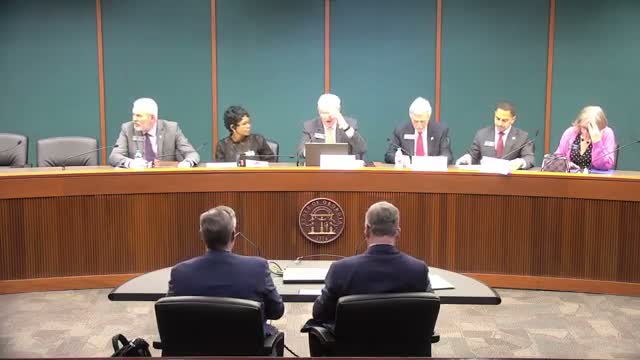
Summary
A Senate committee advanced SB 523 (LC650073), which would establish two statewide Title VI coordinators—one for K‑12 and one for higher education—to centralize complaint intake, investigations and annual reporting. Supporters cited rising antisemitic incidents; critics warned of First Amendment risks and urged broader religious protections.
A Georgia Senate committee voted to advance SB 523 (LC650073), legislation that would create two statewide Title VI coordinators—one for K‑12 schools and one for higher education—tasked with centralizing complaint intake, investigations, corrective‑action notices and annual reporting to state leaders.
The bill’s author, Senator Russ Goodman, told the committee the measure is intended to bring parity with Title IX structures, saying the coordinators would “establish and maintain a uniform complaint submission process, both electronic and written, receive, document, and investigate discrimination complaints, provide written notice to institutions requiring corrective action within 30 days, refer unresolved violations to the U.S. Department of Education and Department of Justice, [and] submit annual reports to state leadership by June 30.” Goodman added the coordinators would be designated by the Board of Regents in consultation with the Technical College System of Georgia and could be assigned to existing personnel; designations were described in the bill as occurring within 90 days of the governor’s signature.
Supporters framed the measure as a practical step to address what they called growing incidents of discrimination. Robert Rothberg of the Georgia Solidarity Network said the coordinators would create “clear intake system[s], prompt response, data and documentation for broader understanding of trends, consistent treatment, and training.” Several public commenters recounted incidents they described as antisemitic or anti‑Muslim on Georgia campuses and urged state action.
Civil‑liberties and community groups raised legal and procedural concerns. Sarah Hunt Blackwell, senior policy counsel at the ACLU of Georgia, opposed the bill’s current text, saying it “threatens to chill constitutionally protected speech” because the measure references the International Holocaust Remembrance Alliance (IHRA) examples codified in state law. Ewan Jang, a former Office for Civil Rights attorney and policy advocacy manager with the Asian American Advocacy Fund, told the committee the bill lacks defined investigative timelines, clear evidentiary standards, notice and appeal rights, and anti‑retaliation protections, and recommended amendments to ensure consistency with federal Title VI standards.
Several commenters from Muslim and interfaith organizations asked that the bill be amended so protections are explicitly extended to students of all faiths. Joahir Sherwani and Arsheila Huda urged language to treat every faith equally; in response, Senator Goodman and staff said implementing agencies (the University System of Georgia, the Technical College System of Georgia, and the Georgia Department of Education) had been consulted and sponsors were open to edits as the bill moves through the process.
Senator Howard offered an amendment to replace lines 29–31 to require schools to consider harassment or discrimination motivated by, or including but not limited to, antisemitism, anti‑Christianity, Islamophobia, anti‑Hindu sentiment, anti‑Buddhist sentiment, anti‑Sikh sentiment and anti‑atheist sentiment. The committee voted the amendment down; the chair said the committee could take up broader inclusions as the bill advances.
After debate and public comment, Senator Hickman moved that SB 523 pass; the motion was seconded by Senator Payne. The chair called for hands for the do‑pass motion, announced the counts on the floor, and declared the bill passed out of committee. The chair and the bill’s sponsor both said more work and refinements would occur as the measure moves forward.
What happens next: With the committee’s do‑pass, SB 523 moves on in the legislative process for further consideration and potential amendment by other legislative committees or the chamber. The committee record shows stakeholders and civil‑rights groups want clarifications on procedural safeguards, evidentiary standards and whether and how protections for other faiths should be included.