
Rep. Washburn introduces option for counties to use purchase price as property assessment; appraisers raise enforcement concerns
Get AI-powered insights, summaries, and transcripts
Sign Up Free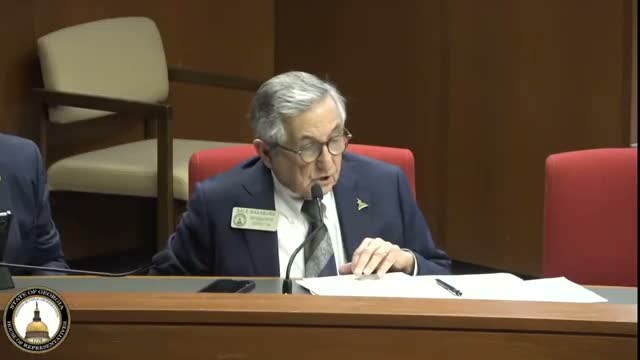
Summary
Representative Washburn presented House Resolution 250, a proposed constitutional amendment that would let counties optionally use a property's purchase price as its assessed value, with reassessment only after sale or major improvements; county assessors and local government groups raised enforcement and equity concerns.
Representative Washburn presented House Resolution 250 to the Ablorem subcommittee, explaining it would amend the state constitution to "let the governing authority of any county or consolidated government adopt an alternative method of appraisal and assessment of real property located within such county." He said the proposal is optional, can be put to a local referendum at the governing authority's discretion, and can be rescinded after five years.
Under the measure as described by Washburn, when a parcel is sold the purchase price would become the assessed value and would remain the assessed value until the next sale. He said the rule would apply to all parcels, not only homesteads, and that "if a substantial improvement is made to the property in excess of $50,000, then it is reassessed by the tax assessors." "This is house resolution 2 50, which proposes an amendment to the constitution," Washburn told the committee, adding that the proposal is intended as an optional alternative rather than a mandate.
County appraisers and local-government advocates testified against the resolution. James Stokes, chief appraiser for Paulton County and legislative director for the Georgia Association of Assessing Officials, said the draft lacks safeguards for declines or destruction of property and could lock taxpayers into assessments after disasters. "There is no allowance in the bill for say a destruction of property," Stokes said, and warned that many transactions are not marketed openly: "Georgia law, under our code section 48 5 2 is no requirement to be advertised to the open market." He said the bill as written would leave assessors with little ability to verify or correct artificially low sale prices from intra-family transfers or private deals.
Nathan Corbett, representing the Association of County Commissioners of Georgia, said ACCG opposed the bill for similar reasons. By contrast, Les Schneider, speaking as a private commentator with legislative experience, urged the committee to preserve the option for counties and argued the measure could increase predictability for taxpayers: "If this system is adopted by a particular county, that digest will grow, and it will grow based on the sales in that county." Schneider also said appeals for diminished value after destruction are available under the resolution.
Committee members asked technical questions about scope and triggers, including whether the $50,000 threshold is a dollar-based trigger for reassessment or tied to a change in market value; Washburn described it as a trigger intended to capture substantial renovations rather than an automatic valuation formula.
No formal committee vote was taken on HR250 at this meeting; the author was told he would be notified about the next subcommittee date. The resolution remains under consideration; proponents characterize it as an optional simplification of the appeals process, while local appraisers and county groups say enforcement and decline-in-value protections need to be clarified.