Get Full Government Meeting Transcripts, Videos, & Alerts Forever!
Get email alerts on the Zoning topic
No spam. Unsubscribe anytime.
Wausau council approves zoning‑code corrections after rejecting effort to strip highlighted conditional uses
Summary
The council passed ordinance 260205 to correct typos and renumber zoning code sections but voted down an amendment to remove highlighted conditional uses (including references to animal boarding, mining and similar operations). The amendment failed 4–7 and the ordinance passed 10–1.
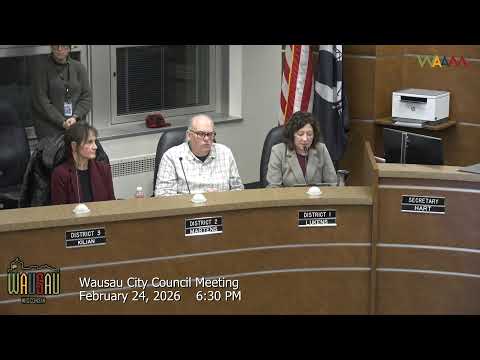
The Wausau Common Council on Feb. 24 approved ordinance 260205, a package of renumbering and clerical corrections to multiple zoning districts, after rejecting an amendment that would have removed conditional uses highlighted in the packet.
Ald. Killian moved to amend the ordinance to exclude the highlighted lists of conditional uses from the vote, citing community concern that permitting certain conditional uses (she cited examples such as mining, waste disposal or freight terminals) without council oversight could expose adjacent neighborhoods and schools to risks. "Do you really want to allow operations related to nonmetallic mining or waste disposal in a current industrial class in a residential neighborhood without council approval?" Killian asked during public comment.
City planning staff (Bill) told the council the changes primarily correct a Municode publication error and restore the numbering and uses to what the council previously adopted in 2020. "It was actually a typo," staff said, explaining that a numbering error put certain permitted uses into the conditional‑use section. Ald. Rasmussen urged caution about using the ordinance to change substantive policy. "If our goal is to amend either the list of conditional uses or what a person does to get [a conditional use], that is a totally separate issue and should come to the plan commission and us as a completely separate effort," she said.
A motion to amend to remove the highlighted conditional uses failed 4–7. The main motion to adopt the ordinance then passed 10–1 (motion from Watson, second Tierney); one councilor voted against the main ordinance. The ordinance text covers revisions to multiple code sections, including single‑family and industrial districts and rules on temporary uses, off‑street parking, external lighting and signage.
Council members who opposed the amendment said the item was intended as language cleanup and renumbering, while those supporting more review said the highlighted conditional uses warranted more public and committee scrutiny.