Get Full Government Meeting Transcripts, Videos, & Alerts Forever!
Get email alerts on the School Funding topic
No spam. Unsubscribe anytime.
Presenter outlines SEA 1's projected hit to district revenue and plans to protect classroom spending
Summary
At a Taylor School Board meeting, staff reviewed how SEA 1 and lower student counts will reduce assessed values and drive large circuit-breaker losses, shrinking operations revenue; the district plans efficiency measures (including a solar study) and says it will not cut salaries.
Presenter (speaker S1) told the Taylor School Board that recent state changes commonly referred to as SEA 1 will alter how school funding is calculated and reduce local revenue available for operations.
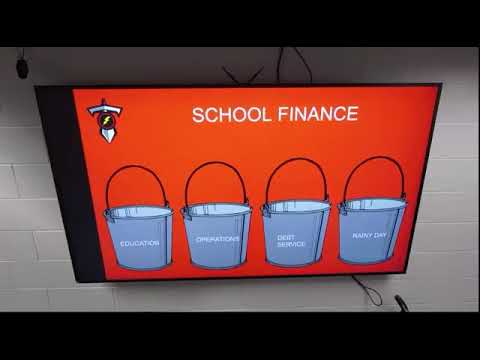
"It's all gonna affect us here in the next couple of years," S1 said, outlining the district's four primary funds (education, operations, debt service and rainy day) and the rules that prevent moving money freely between those buckets.
S1 walked the board through the mechanics: the education fund is driven by average daily membership (ADM) and pays instructional staff, while operations covers transportation, custodial services, utilities and building maintenance. The presenter said the district's ADM snapshot stands around 1,107 and that the state now rolls previously separate curriculum-materials payments into the foundation/ADM calculation, removing a separate $151-per-student check for curricular materials and devices.
S1 summarized the projected fiscal impact: lower net assessed values plus growing circuit-breaker losses will reduce property-tax revenue the district can collect. "If nothing changes at this session this spring," S1 said, the district's operations revenue could decline sharply in coming years, with illustrations showing operations receipts dropping toward a crisis point in the later projection years.
Board members asked about revenue drivers and local policy options. S5 (board staff) explained that rainy day rules are locally defined and that the board may move limited percentages from education into rainy day (subject to statutory caps), but that such transfers are constrained. S1 noted the district's net assessed value increased 9.1% this year but warned the new law's mechanics show negative net assessed values for many future years and that the district will likely rely on rainy day reserves and targeted cost-savings.
On specific state changes, S1 highlighted two major items: the consolidation of curriculum-account payments into ADM/foundation dollars (reducing dedicated reimbursements for books and devices) and a change in business personal-property thresholds that shifts more taxable equipment below the exemption threshold, lowering revenue. S1 also described how local redevelopment commission tax-increment arrangements (so-called "tipping") can divert new growth away from school tax levies for defined periods, limiting near-term revenue from new housing or commercial development.
The presenter emphasized priorities for protecting classroom services: conducting an energy/efficiency audit (including a solar feasibility study), reviewing staffing and service-contract savings, maximizing grant opportunities, and considering bond-refinancing to lower debt service costs. S1 said the district recently moved a solar project to debt service and staff will complete a full vendor survey of buildings and utilities before recommending action.
S1 closed by saying the board will not pursue salary or benefits reductions: "We are not going in for any salary reductions, benefit reductions, or professional development that we've, like, relied on so much this last year." The presentation and supporting slides will be distributed to the board and staff will follow up on outstanding questions about redevelopment tips and projected revenue scenarios.
Next steps: staff will provide the full slide packet, answer outstanding questions about tipping/TIF arrangements, and schedule follow-up meetings after the vendor completes the energy survey.