Get Full Government Meeting Transcripts, Videos, & Alerts Forever!
Get email alerts on the Downsizing Carrie Gosch topic
No spam. Unsubscribe anytime.
School City of East Chicago proposes downsizing Carrie Gosch Early Learning Center to cut $4 million in costs
Summary
District leaders told families at an informational meeting that closing the Carrie Gosch Early Learning Center would help the district address a projected $4 million shortfall; pre‑K will continue in four elementary schools with new eligibility and operational rules, but parents and staff warned the move could erode special‑education services and community partnerships.
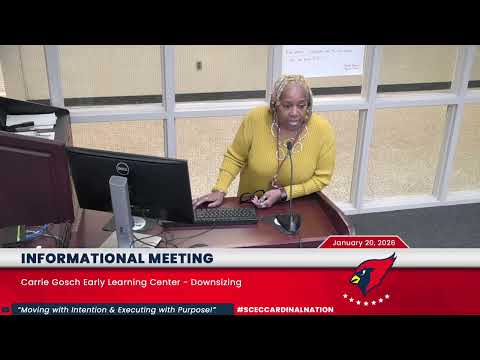
School City of East Chicago officials presented a plan at an informational meeting to downsize the Carrie Gosch Early Learning Center as part of efforts to curb a projected $4 million budget shortfall. The superintendent said the district will keep its pre‑K program but move it into four elementary schools and change eligibility and operational rules.
The superintendent, speaking to families and staff, said the decision grew out of a financial forecast shared with the board and a combination of shrinking federal and state funding, charter enrollments and declining district enrollment. "We are closing the early learning center. We are not getting rid of the pre kindergarten program," the superintendent said, adding the district aims to "shave somewhere around $4,000,000 in the next 2 years." She said operating the Carrie Gosch building costs roughly $2,000,000 a year while reimbursements from the state are approximately $25,000–$40,000.
Under the recommendation, pre‑K will continue in Harrison Elementary, Lincoln Elementary, McKinley and Washington Elementary. The district projected about 14 pre‑K classrooms across those sites (Harrison 3, Lincoln 2, McKinley 3 and Washington 5) to accommodate an estimated 203 students; Carrie Gosch currently has about 15 classrooms. The superintendent said the relocated pre‑K will be limited to 4‑year‑old East Chicago residents and that students must be toilet trained — a change from the current model. School hours for relocated pre‑K students were described as a full day, approximately 9 a.m. to 2:30 p.m.; dedicated pre‑K bus routes and meal arrangements (breakfast in class, lunch in classroom or cafeteria depending on the building) were also described.
District staff described how services for exceptional learners will be handled. Mary Jensen said students who qualify for special education will continue to receive services in buildings within their zone and that licensed special‑education teachers and related services (speech, occupational and physical therapies, applied skills and resource teachers) will migrate to the receiving schools. She clarified that children with IEPs are not required to be toilet trained.
Parents, paraprofessionals and other staff raised sharp concerns. Suzanne Chick, a Carrie Gosch social worker, told the board that the building houses the city's only pre‑K testing center and contains multiple gross‑motor rooms and specialized therapy space that she said cannot be replicated in elementary schools. "We are the only testing center in the whole city for pre k...It cannot be created in the elementaries," Chick said, urging board members and administrators to visit the facility before final action. Paraprofessional Tashana Tyner said many paras have received notices to reapply and asked where funding for those positions will come from; the superintendent said staffing questions will be addressed in a follow‑up meeting with human resources and the elementary department.
Families asked how the district would avoid overloading receiving classrooms and whether the same adult support and rapid teacher‑family communication would continue. Several speakers described close relationships with Carrie Gosch staff and cited specific services and community partners — including the EC Public Library, mobile dental services and local nonprofits — housed in the building's parent cafe and programming.
The superintendent said the board will consider a resolution on the recommendation at its next regular board meeting (she said "next Tuesday") and that a media and communications plan will begin Jan. 28 with FAQs posted on the district website. She said the district expects most information to be ready by the kindergarten roundup on March 19 and listed the last day for students at the building as May 28 and for staff as May 29. The district emphasized that additional meetings — including staff‑level and HR sessions — will follow to plan placements and answer detailed questions.
No formal vote or board action on the recommendation was recorded at the informational meeting. The superintendent said the district's goal is to invest any savings back into the broader corporation to support infrastructure and instruction beyond 2027.
The district cited the Indiana Department of Education kindergarten readiness standards as the curricular framework for relocated pre‑K classrooms and said state‑approved assessments (iSprout and others) will continue to be used. Officials also noted that decisions about bilingual classroom locations and the applied skills classroom will be made based on highest need and available space.
Next steps: the board's resolution vote (date and outcome to be recorded at the regular meeting), a series of staff and HR meetings to address reassignment and hiring questions, and a public communications rollout that the district said will include an FAQ and site‑assignment notices for families in advance of the 2026–27 school year.