Get Full Government Meeting Transcripts, Videos, & Alerts Forever!
Get email alerts on the School Finance topic
No spam. Unsubscribe anytime.
Pelican Rapids board approves $4.3 million levy after truth‑in‑taxation presentation
Summary
After a truth‑in‑taxation presentation outlining state funding shortfalls and the district’s property‑wealth dynamics, the Pelican Rapids Public Schools board approved a levy certification totaling $4,300,723.95 to help close the per‑pupil funding gap.
Mr. Matthews, the district presenter, told the Pelican Rapids Public Schools board that the levy the board was considering is set on a calendar year and that the dollars approved at the meeting would be collected next year.
He walked trustees through state and local revenue components, saying statewide public schools receive roughly 72% of funding from state aid and about 16% from property taxes, and that Pelican Rapids relies more heavily on local revenue. "We continue to be severely underfunded in the state of Minnesota when it comes to public education," Mr. Matthews said, adding the district receives $7,481 per pupil under the current formula and that an inflation‑adjusted figure would be about $8,951 per pupil.
Those gaps, Mr. Matthews said, are part of why the board seeks local levy revenue and why some levies are restricted or earmarked for specific programs (for example, career and technical education revenues that must be spent on those programs).
He also described the district’s property‑wealth picture: about $3.2 billion in property wealth lies inside the district footprint and roughly $2.1 billion of that is seasonal‑recreational property that is currently excluded from certain levy calculations. "If we include the other $2,100,000,000 in our school district, the impact of levies would be significantly lower," he said, urging continued advocacy to change how seasonal properties are treated at the state level.
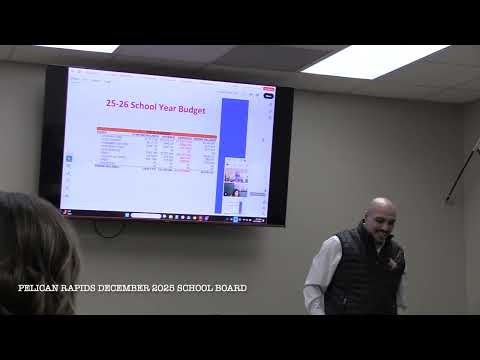
On budget specifics, Mr. Matthews said community education revenue is up by about $56,000 while debt service declined modestly, and that the net levy increase from last year is roughly $23,000 — “just a little over half a percent” for taxpayers, he said. He also alerted the board that staff will propose a budget revision at the board meeting in January to reflect current enrollment and revenue realities.
Following the presentation, the board moved and approved the levy limitation certification report for 2025 (payable 2027) with a stated total of $4,300,723.95. The motion carried on a roll call with all members voting in favor.
The levy certification now establishes the district’s levy for the calendar period described in the motion; Mr. Matthews and district staff said resources will be rechecked in the January revision to ensure the budget reflects current student counts and revenue flows.