Get Full Government Meeting Transcripts, Videos, & Alerts Forever!
Get email alerts on the Academic Metrics Overview topic
No spam. Unsubscribe anytime.
Lincoln Public Schools presents academic measures beyond the state Aquest score
Summary
District staff told the board that a single Aquest rating does not capture school-level progress and presented multiple metrics — early literacy gains, national MAP comparisons, ACT and AP results, and programs such as AVID and Career Academy — as evidence of student growth.
The presenter for Lincoln Public Schools told the Board of Education that "every chart, every piece of data is a student. There's a teacher behind it," framing a district briefing that emphasized multiple measures of school performance beyond Nebraska's Aquest accountability rating. The presentation was the first in a series the board requested to align superintendent priorities with measurable outcomes.
The district highlighted McPhee Elementary's move from a '2 good' to a '3 great' Aquest rating, and said that underlying indicators explain the change: a 10-point jump in science proficiency, 77% of students showing growth on the state test, and more than 60% of English learners improving on the ELPA assessment. The presenter stressed those school-level gains as the meaningful signal behind headline ratings.
Staff described the district's continuous-improvement cycle: principals attend a two-day school improvement workshop, teams review monthly progress monitoring, and instructional round tables serve as a first-quarter pulse across all 70 schools. The presenter said district assessment staff compile and organize the data that school teams use to set and monitor plans.
For middle grades the district uses MAP Growth (national percentiles) to compare students nationally; the presenter noted that grades above the 50th percentile indicate students outscoring the national median. At the high-school level the ACT is used for cohort reporting: the presenter said the LPS average composite is about 19.7 and emphasized that LPS tests roughly 95% of students, making direct comparisons to states that test far fewer students context-dependent.
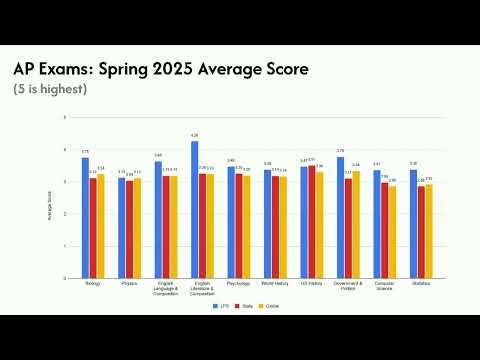
The presentation also covered AP exams and honors access, noting LPS outscored the state and global averages on selected AP assessments and pointing to board-supported action steps to encourage more students to attempt honors- and advanced-placement coursework. Staff credited AVID and belonging initiatives with gains in honors participation among historically underrepresented groups.
The briefing closed with next steps the district will pursue, including science-of-reading professional learning, a math-curriculum pilot reported to the Student Learning Committee, expansion of AVID to all secondary schools, and intensified attendance supports to address chronic absenteeism.
The board thanked staff for the briefing and offered congratulations on the reported gains. The presenter said this is the first of several planned reports that will examine inputs such as student belonging and partnerships that support the outcomes presented.