Get Full Government Meeting Transcripts, Videos, & Alerts Forever!
Get email alerts on the HVAC Costs topic
No spam. Unsubscribe anytime.
Task force confronts ballooning HVAC estimates; engineers say full‑system replacement explains higher price
Summary
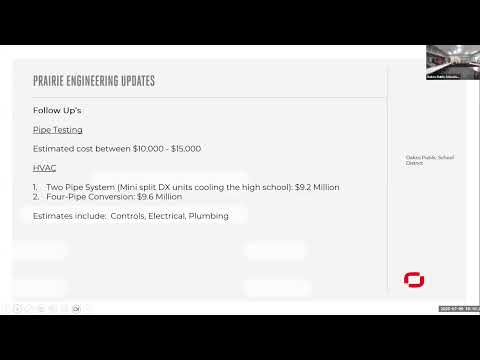
Members expressed alarm after engineers presented full-system HVAC estimates rising to roughly $7M (high school) and $9.2M (whole campus); presenters said a full replacement, not a phased/strategic fix, produced the higher numbers and offered to re-run costs for a high‑school‑only scope (~$5M).
Task force members pressed engineers and consultants about rising HVAC estimates and differing interpretations of scope after recent meetings.
A presenter for Prairie (S7) explained that their current estimate assumed a complete mechanical replacement across facilities and that a comprehensive solution—new piping, chiller and controls—drove the $9.2 million total. The presenter offered to re-price a high‑school‑only package, which they estimated would return to a roughly $5 million ballpark for that narrower scope. “The entire facility is the 9.2,” the presenter said; “if we misunderstood that you only wanted to do the high school, we'll pull that up and get that… you'll be back at about a $5,000,000 ballpark number.”
Several task force members said they had previously understood the group to be considering strategic or partial replacements that were significantly less costly. One member characterized the new numbers as “misleading” because the scope underlying the cost was not consistently communicated between meetings; another warned a large, unclear dollar figure would undermine public trust during any referendum. Members called for a clear, concise summary of how estimates were derived so the group can present consistent figures to voters.
Engineers also discussed non‑destructive versus destructive pipe testing and warned that certain investigative approaches—particularly cutting into closed piping loops—can force failure modes and produce additional needed repairs. Prairie estimated limited destructive testing could cost in the low‑to‑mid five figures, and they cautioned that such testing carries the risk of creating new, immediate repair needs.
Next steps: engineers agreed to break out line‑item cost estimates by building and to provide a high‑school‑only budget to compare with the full‑system numbers; the task force asked for contractor bids and clarified that any survey or referendum materials must present a single, consistent set of dollar figures.