Get Full Government Meeting Transcripts, Videos, & Alerts Forever!
Get email alerts on the Education Ai topic
No spam. Unsubscribe anytime.
Bronxville students demonstrate AI projects as district pilots draft guidelines
Summary
Three Bronxville High School students demonstrated AI projects — from regression models to image-recognition neural networks — while the district unveiled draft guidelines, a student checklist and an AI assessment scale to pilot this semester and be shared with parents in March.
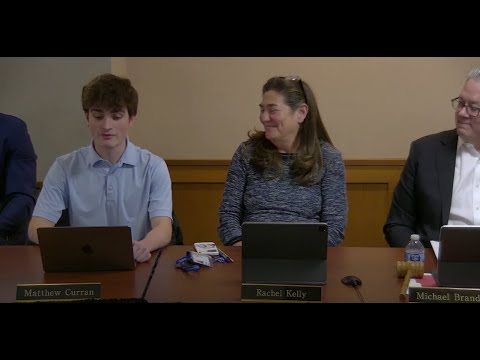
Three Bronxville High School students presented their independent-study work on artificial intelligence to the Bronxville Union Free School District board, and district leaders outlined draft guidelines and tools to govern classroom use of AI.
Eleanor Fahey, a student in the district's advanced AI course, described a linear regression project that used Python and a large dataset to predict used-car prices, saying, "we're actually able to create a graph...and turn them into real world applications" (Eleanor Fahey, student). Another student described using logistic regression to classify cells as malignant or benign and said the class chose to "favor false positives over false negatives" in training models for safety. A third student overviewed neural networks and image-classification work that used roughly 1,200 images to train convolutional models.
Anne Meyer, the assistant superintendent for curriculum and instruction, told the board the district has formed an AI committee of faculty, students, parents and board members that began work in October and conducted focus groups across grade levels. Meyer said the district will pilot three tools this semester: district AI guidelines, a student-facing checklist to document AI use and an "AI assessment scale" that clarifies how much AI is allowed on a given assignment. "Make it your goal to become skilled in using AI comfortably, effectively, safely, and ethically," Meyer said of the draft guidance.
Meyer said the resources the district reviewed include university frameworks (Elon University and AAC&U), UNESCO's AI guidance and recent materials from the New York State Library Association and the U.S. Department of Education. The draft guidance and checklists will be shared with high-school faculty for feedback, presented to students at the start of the second semester and discussed with parents at a districtwide PTA meeting in early March.
Board members asked students about data sources and surprising model behavior; students said many datasets were publicly available and emphasized the need to run models multiple times to improve accuracy. The district plans professional development on pilot software for faculty and to collect feedback at the end of the semester before finalizing any policy.
The district presentation concluded with a pledge to keep communication open among teachers, students and parents as the district refines its approach to AI instruction.