Get Full Government Meeting Transcripts, Videos, & Alerts Forever!
Get email alerts on the School Facilities topic
No spam. Unsubscribe anytime.
Bexley trustees hear survey results as committee recommends new middle school, hybrid funding and more time to educate voters
Summary
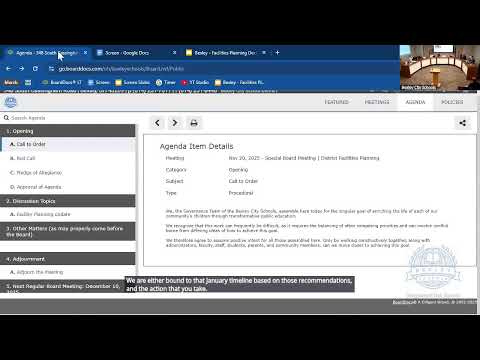
At a Nov. 20 special meeting, the Bexley Board of Education heard a community survey showing broad satisfaction with local schools and a facilities advisory committeerecommendation to prioritize a standalone middle school, outdoor space improvements and a hybrid funding plan; the board and committee debated whether to seek voter approval in May or November.
BEXLEY, Ohio Nov. 20, 2025 The Bexley Board of Education on Thursday heard results of a district-commissioned public-opinion survey and a slate of recommendations from a combined facilities and finance advisory committee that would prioritize a new middle school and a mix of funding options.
Dr. Fine, who opened the special meeting, said the session was intended to "provide the Board of Education with information needed to inform some really important upcoming decisions," and reminded the audience that there would be no public comment at the meeting.
Paul Fallon, a public opinion researcher with Fallon Research and Communication, summarized the survey methods and topline findings, saying the study completed Oct. 29 through Nov. 4 interviewed 384 adults in the Bexley City School District and carries an estimated margin of sampling error of about plus-or-minus 5 percentage points. "A whopping 89% were satisfied with quality of life here in Bexley," Fallon said, and he reported that roughly three in four respondents said they were satisfied with the district overall.
Fallon said the survey showed strong community interest in priorities such as STEM programming and near-term facility repairs (HVAC, boilers and roofing), while responses were mixed on a specific proposal to build a new middle school on the Cassingham softball field. "When we asked whether to build a new middle school on the softball field at the current Cassingham site, 46% said it was a good idea, 30% said it was bad and 24% were unsure," he said, adding that parents and "future parents" tended to be more supportive than nonparents.
Fallon also summarized open-ended objections among respondents who opposed the middle-school plan: 27% said it was "not needed or there are other priorities," and 26% said "taxes will go up or the project's too expensive." He stressed that the "unsure" responses were a substantial share of the sample and noted the limits of treating a community survey as a vote forecast.
After Fallon's presentation, Larry Hellman, a longtime Bexley resident and member of the combined advisory committee, reviewed site constraints at the Cassingham complex and argued the district is "land poor," with about 22 acres for five buildings and limited options for future expansion. Hellman described capacity and circulation challenges at the campus and urged long-term, phased planning rather than piecemeal additions.
Ted Cahill, speaking for the combined facilities and finance advisory group, outlined how the committee worked (roughly 50 volunteers in repeated meetings and a 60% consensus rule for committee recommendations) and said the group landed on three priorities for phase 1: a standalone middle school to address overcrowding and identity, outdoor and field improvements at the Maryland and Montrose sites to increase usable green-space days, and a set of capital expenditures to preserve existing buildings and allow future phases to proceed.
On financing, committee members and staff explained three basic options: bonds supported by property tax, certificates of participation or similar instruments tied to an income-tax component, or a hybrid. Kyle, who worked on the committee's modeling, presented example estimates and cautioned they are preliminary. He described a spreadsheet-based simulator the committee used and gave example figures shown on slides: a hypothetical millage and income-tax blend that produced an estimate of about $263 per $500,000 in property value in one scenario, and an illustrative household comparison that the presenters said equated to roughly $1,250 a year for an example household using a set of median assumptions.
The committee recommended taking the proposal to voters in May, but several presenters and some board members urged waiting until November to allow more time for public education and higher turnout. Cahill warned that a rushed calendar could leave voters "without enough time to get the information they need," and several trustees noted turnout differences between May primary elections and November general elections.
District staff also detailed procedural deadlines: the presenters said a hybrid proposal with a bond component exceeding roughly $28 million would require state consent and would affect the timing of necessary resolutions and filings with the county auditor and the Ohio Department of Taxation. Dr. Fine said a core team would reconvene immediately to refine cost and funding details and that she expected a formal recommendation on timing (May or November) at the December board meeting.
No formal ballot resolution was voted at the meeting; the only procedural motions recorded were approval of the brief agenda and a voice vote to adjourn. The board is expected to receive a refined recommendation from staff and the core team before taking any formal action to place a measure on a ballot.
"You've got people's attention," Fallon said of the district's outreach; trustees and committee members said they wanted to use the next weeks to answer community questions about costs, green space and the sequence of phases before asking voters to decide.
The meeting adjourned after a motion, second and voice vote.