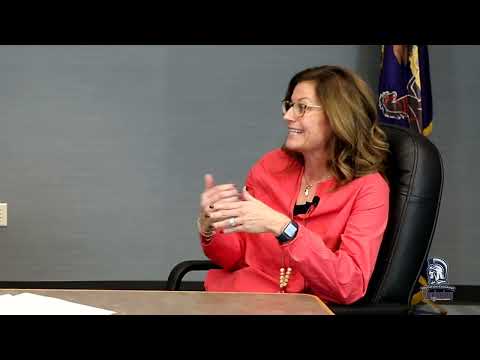
Chambersburg superintendent interviews intervention specialist on earlier math expectations, teacher supports
Loading...
Summary
Amber Myers, an intervention specialist with Chambersburg Area SD, says students now learn basics of fractions in first grade and that instruction emphasizes explaining strategies and building fact fluency; the district has added content specialists and set a fifth-grade fluency goal.
Chris Bigger, superintendent of Chambersburg Area SD, interviewed Amber Myers, an intervention specialist at Stevens Elementary, about changes in elementary math instruction and district support strategies.
Myers, in her 25th year with the district and 30th year teaching, said expectations for young students have shifted toward conceptual understanding and the ability to explain mathematical thinking. "Kids are learning fractions in first grade," she said, pointing to classroom activities that use halves, sharing and informal models such as pizzas to introduce the concept.
The move, Myers said, pairs content standards with "process standards" that ask students not only what they did but why and how. She cautioned that offering multiple solution strategies can confuse some learners and recommended focused approaches for students who need them while preserving flexibility for others.
Myers disputed the notion that recent standards deprioritize arithmetic facts. "Fact fluency is just as important as what it was before Common Core," she said, adding that automaticity remains a district priority even as instruction emphasizes conceptual understanding.
For parents, Myers suggested practical steps to support numeracy: maintain a positive attitude toward math, reduce screen time, talk about estimates during routine activities such as grocery shopping, and play board games to build early number sense.
Addressing classroom practice, Myers said teachers should combine energetic whole-group lessons with targeted small-group instruction to address specific skill gaps. She noted the district is building teacher capacity through content specialists assigned by grade level; those specialists act as liaisons and coaches, providing grade-specific support and relaying teacher feedback to the district.
Looking ahead, Myers highlighted a district fluency goal for fifth grade and said defining what fluency looks like will help teachers and students set measurable targets. The district is aligning that work with its broader 'schools of distinction by 2030' initiative.
Bigger said the podcast will revisit progress in a few months. "We'll circle back and continue this conversation in a couple months to see what progress we make," he said.