Get Full Government Meeting Transcripts, Videos, & Alerts Forever!
Get email alerts on the Campus Center Design topic
No spam. Unsubscribe anytime.
Miller Dunwoody presents 'Campus Center' design emphasizing sustainability and campus connections
Summary
Miller Dunwoody Architects told the State Designer Selection Board its Campus Center concept for the University of Minnesota, Saint Paul, would prioritize interlocking student, library and community uses, strong indoor-outdoor connections and aggressive energy goals tied to B3 and SB 2030, the firm said.
Miller Dunwoody Architects outlined a vision for a new University of Minnesota Saint Paul Campus Center that prioritizes integrated student services, stronger campus connections and ambitious sustainability targets.
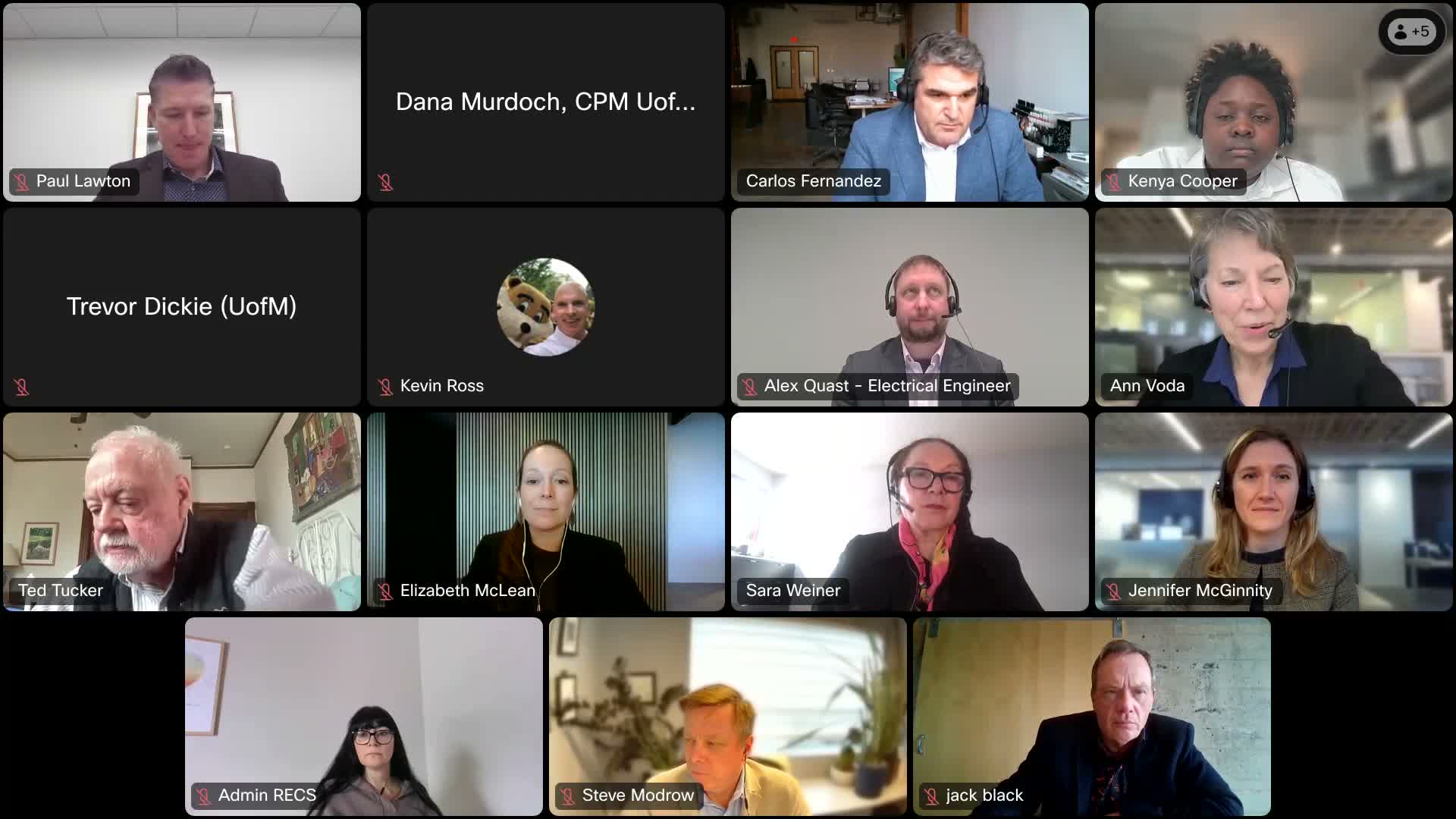
"Embedded in the simple title Campus Center is the full complement of opportunities and responsibilities of this project to the students first," Anne Voda, the firm's principal in charge, said during a 20-minute presentation to the State Designer Selection Board.
The team described a program that unites student life, library services, research, gathering and supportive retail into a flexible co-curricular "learning ecosystem." Elizabeth McLean, identified by the team as the design manager, said the plan favors a mix of reservable and casual spaces, and flexible "stacking" of program elements so the building can serve individuals and large events across daily and seasonal rhythms.
Design concepts offered ranged from a "big roof" that frames outdoor rooms and supports rooftop photovoltaics to more permeable, pavilion-like arrangements that open in multiple directions. Jack Black, the design principal for an associate firm on the team, cited precedents at Salisbury and Clemson to illustrate large civic rooms and campus-scale transparency.
Site strategies highlighted opportunities for placemaking: reworking circulation, greening edges, stormwater-focused streetscape design and stronger visual and physical connections to nearby campus features including the Ben Pomeroy Alumni Center. "We just have to take a hard look at what trees we can preserve," Carlos Fernandez, the team's landscape speaker, said, adding that preserved specimens and a campus-led planting strategy would be coordinated with campus forestry.
Energy and performance were central to the pitch. The team said it would establish an energy-use intensity (EUI) target early, benchmark performance, measure embodied carbon and evaluate rooftop PV and geothermal as part of an integrated energy strategy. "90% is a big challenge," Alex Quast, the electrical engineer on the team, said of meeting the B3 and SB 2030 reduction goals, noting the team would use detailed modeling to reconcile systems, envelope and operational trade-offs.
Board members asked detailed follow-up questions about local presence, coordination, how the campus arboretum would be integrated and mechanisms to interlock historically siloed programs. The team responded that it can support both long on-site presence and focused work sessions, will test multiple floor-plan scenarios to distribute visible program elements and will iterate studies to combine strongest ideas into a final composition.
The presentation closed with Voda reiterating that the firm's approach pairs community engagement with technical rigor. The State Designer Selection Board paused public recording to deliberate; the board said it will select two of three firms to forward to the university for final decision.