
Design team tells State Designer Selection Board their campus center plan prioritizes program integration, mass timber and B3 energy goals
Get AI-powered insights, summaries, and transcripts
Subscribe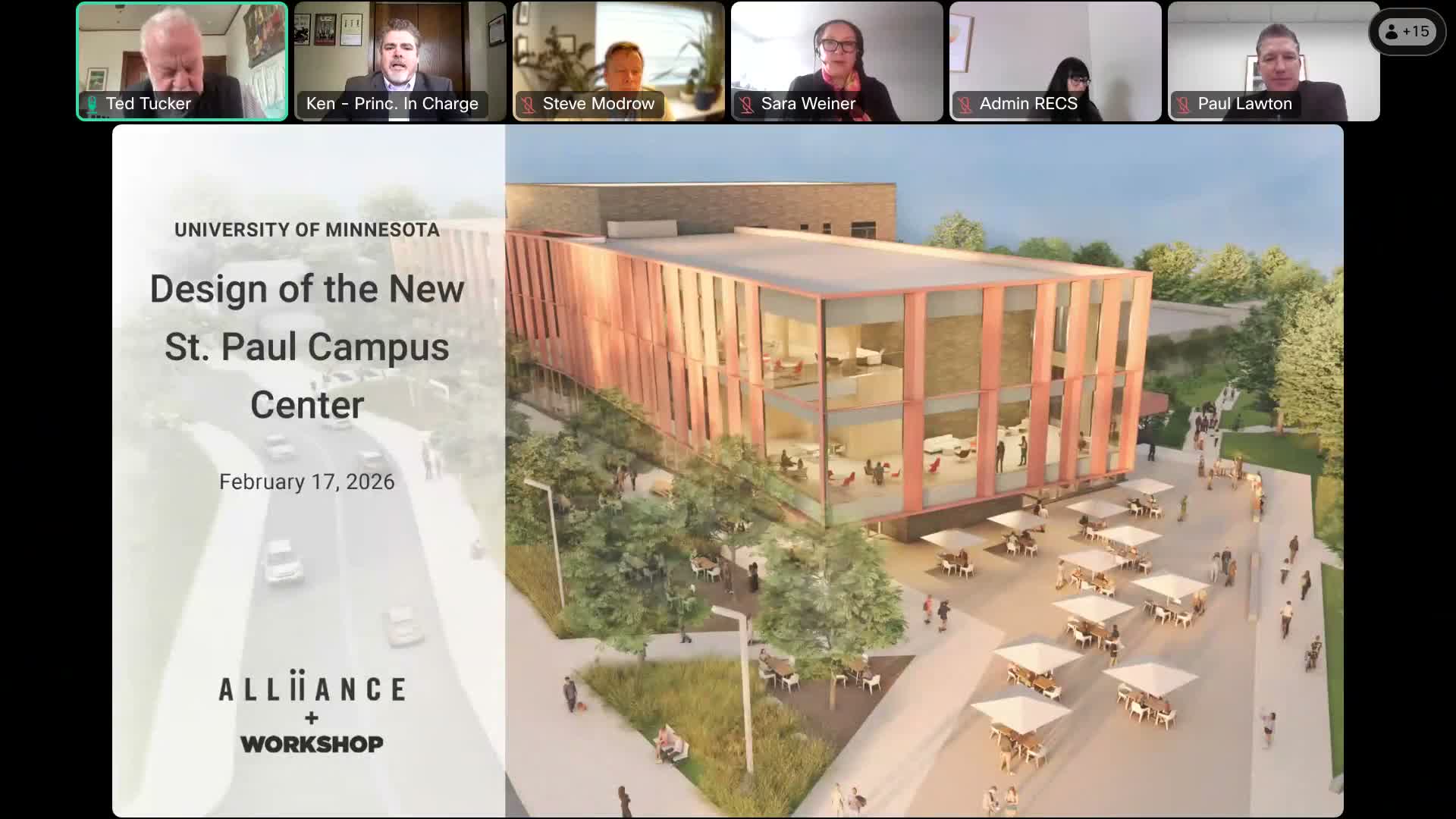
Summary
Alliance/Workshop presented a predesign for the University of Minnesota Saint Paul campus center, emphasizing program integration of student union and library functions, mass-timber construction to reduce weight and improve character, and strategies to meet Minnesota's B3 energy targets; the board will announce its selection decision shortly.
The State Designer Selection Board on Monday interviewed the Alliance/Workshop design team on a predesign for a combined student center and library at the University of Minnesota's Saint Paul campus, hearing details about program integration, site constraints and sustainability goals.
Ken Sheehan, the project's principal in charge, told the board the design team brings continuity from four years of predesign work and extensive campus experience, saying, “We bring tremendous expertise to the project, and we bring the continuity of having a depth of experience, obviously, with the predesign and feasibility study.” He listed the project team and consultants and said that continuity would let the team move into refinement rather than redoing prior decisions.
The nut graf: The team argued the project's value lies in co-locating student life, retail and library functions to create a social hub for the Saint Paul campus while managing complex site conditions (26 feet of existing grade change, extensive subsurface utilities and contaminated soils). They also described an approach to meet Minnesota's B3 energy goals and the use of mass timber to reduce structural weight and improve the building's character.
In the presentation, the team outlined schedule and delivery plans that include a one-month predesign validation followed by coordinated design phases and a CM-at-risk delivery strategy intended to support early bid packages and a targeted summer 2029 occupancy. A member of the presenting team described the engagement cadence: monthly stakeholder workshops and weekly management meetings to lock scope, schedule and budget.
On program, the designers said they worked with library, student-union and auxiliary services partners to avoid duplication and to integrate functions so the building can serve as a campus —living room.' The presenters described a multi-level plan: a main level oriented to student life and events that spill to an outdoor plaza; a second level focused on union collaboration and student organization spaces; and an upper level blending library collections, an Information Commons and makerspaces.
The team also identified substantial site constraints. They said the site has roughly 26 feet of grade change, an unusual pattern of steam lines and other utilities, and contaminated soils on the south quad from a demolished power plant — conditions that influence construction strategy and stormwater management. The designers proposed terracing and regraded approaches to restore a north-south campus spine and create an at-grade main plaza to improve campus circulation.
Sustainability and energy performance were a recurring topic. Ned Rector, the project's mechanical/electrical/plumbing representative, told the board that the B3 energy-performance requirements shifted during the predesign process from an 80% energy-reduction target to a 90% goal (relative to a 2003 benchmark), and he said the team can pursue a net-zero option but that meeting the higher reduction target practically requires on-site renewables. Rector summarized trade-offs in ventilation and HVAC approaches and warned of the risk that a very high-performance building can act as an —energy island' if it cannot integrate with campus distribution systems.
Ernesto, the design lead for core and shell, discussed mass timber as both an aesthetic and technical choice: "mass timber really came to our minds right away as something that has the built in warmth and character, to create the kind of inviting open building for the student experience." He added the lighter structural weight of mass timber could allow reuse of existing foundations and shorten erection time.
Board and agency members pressed the presenters on trade-offs and continued engagement. Sarah Holtzweiner, an architect representing the Minnesota State Arts Board, asked about "deliberate trade offs and resolved priorities," and the team said those priorities have been stable through successive predesigns but that implementation evolved to address site and utility integration. An agency questioner asked how student engagement would continue when formal student governance had been restructured; the team recommended widening participation beyond the student advisory board and using mockups and VR tools during design development to get broader feedback.
On landscape, the design team said they would protect heritage trees and use planting strategies informed by historical (pre-settlement) plant communities to make the site both educational and wellness-oriented. The landscape lead noted close coordination with campus Landcare to identify trees to preserve.
There were no formal votes or motions during the interview. Chair Ted Tucker closed the session by saying the board's executive secretary would inform the presenting team of the selection decision that afternoon or the next day and paused the meeting for a break.
The board will announce its decision through the executive secretary; in the meantime the design team will be available for follow-up questions and clarifications requested during the Q&A.