Get Full Government Meeting Transcripts, Videos, & Alerts Forever!
Get email alerts on the Education Finance topic
No spam. Unsubscribe anytime.
Chief recovery officer outlines multi-year financial recovery plan for Steelton‑Highspire School District
Summary
Terry Mathias, the chief recovery officer assigned to Steelton‑Highspire School District, presented a 97-page financial recovery plan that outlines 32 initiatives across academics, administration, operations and finance, cites a negative $4.366 million fund balance (06/30/2022), and says the board will vote on the plan on Aug. 6.
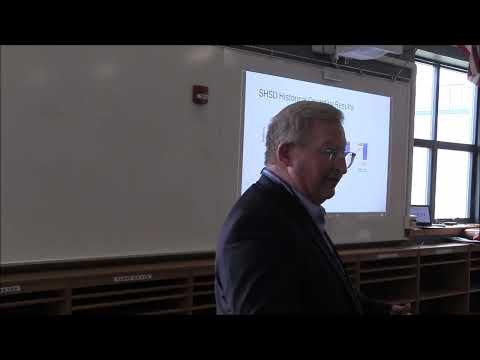
Terry Mathias, the chief recovery officer assigned to Steelton‑Highspire School District by the Department of Education, presented a multi-year financial recovery plan in a public meeting and said the school board will vote on the plan at its Aug. 6 meeting.
Mathias said the plan, available on the district's website, is forward-looking and meant to be implemented over several years by the board, superintendent, staff and community. "The plan guides the leaders of the school district in a process towards continuous improvement," he said.
The presentation summarized the district's recent financial picture, citing audited years 2017–18 through 2021–22 and saying the audited fund balance as of June 30, 2022 was negative $4,366,000. Mathias told attendees there have been no annual financial reports completed for the two years after that audit, which means the current shortfall could be larger than the last audited figure.
Mathias described operational and cash-management challenges: timing differences between when property and earned-income taxes are collected and when payroll and contracted services are paid; a pattern of deferring payments into subsequent fiscal years; and data and staffing gaps in the business office that obscure current liabilities. He said an auditing firm is working on the 2022–23 audit and the district is supplying information to complete back audits.
The plan lays out 32 initiatives across four areas (academics, administrative policies and procedures, financial management, and operations). Finance-focused measures Mathias highlighted include negotiating affordable contract and benefit packages, analyzing health-care contributions, "right-sizing" the workforce to align with comparable districts, limiting growth in special-education spending to peer averages while complying with federal obligations, increasing Medicaid-access reimbursements, pursuing supplemental grant funding, and considering adjustments to real-estate tax rates using the outgoing index.
Mathias said the district used bond proceeds in recent years to cover liabilities but still faces sizable unpaid expenditures; he told the meeting the district's outstanding liabilities reached $10.9 million in "24/25" as presented and that over $3 million in current unpaid expenditures remain. Mathias cautioned that some year references in the presentation reflect unaudited periods and that precise current totals will be clearer after the pending audits are completed.
On academics, Mathias showed PSSA (grades 3–8) and Keystone (high-school) test results, graduation and attendance trends and career-readiness metrics, and tied improvement in those areas to the statutory criteria for exiting recovery. "We can't just save money," he said. "We have to improve academics."
Mathias described statutory exit requirements he said are in the school code: maintain a positive fund balance for a defined period, demonstrate successive years of positive financial results, provide five-year balanced projections, and show substantial progress on academic and graduation goals. He also described the required financial advisory committee membership and named board members, district leaders, a charter-school representative, two community members, a teacher and the IU representative as participants.
Residents raised questions during the presentation. One resident said a firm had been paid to do audits; Mathias responded that the auditing firm is working on the 2022–23 audit and staff are compiling information for prior years. Another attendee asked whether a transition loan from the Department would have to be repaid; Mathias confirmed it is a loan, not a grant, and said such loans are available if the district demonstrates readiness and a balanced budget plan to prevent future misuse of funds.
Mathias repeatedly emphasized the importance of timely, accurate data and standard operating procedures so the district and board can make informed decisions. He said he contracted to remain during the implementation phase of the recovery process unless personal circumstances prevent it.
The board will consider the presented recovery plan at its Aug. 6 meeting; Mathias said board approval would allow the district to implement the plan and continue receiving state technical assistance. If the board rejects the plan, he said, state technical support would end.
This article is based on a public presentation by Terry Mathias and exchanges with meeting participants; no formal board vote on the plan was recorded during the presentation.