Get Full Government Meeting Transcripts, Videos, & Alerts Forever!
Get email alerts on the Assessment Pilot And Variance Request topic
No spam. Unsubscribe anytime.
Board hears early CPAS pilot results; University of Minnesota program asks for edTPA variance
Summary
Staff reported early, limited data from the CPAS pilot (a two‑year pilot begun Dec. 2024) and said they will request more data this spring. Carla Stone of the University of Minnesota asked the board for a variance to allow an alternative summative assessment in lieu of the edTPA for ESL and world‑language candidates this spring.
At its Jan. 23 meeting, the Professional Educator Licensing and Standards Board received an update on the CPAS teacher‑performance assessment pilot and heard a public comment asking for temporary flexibility on edTPA requirements.
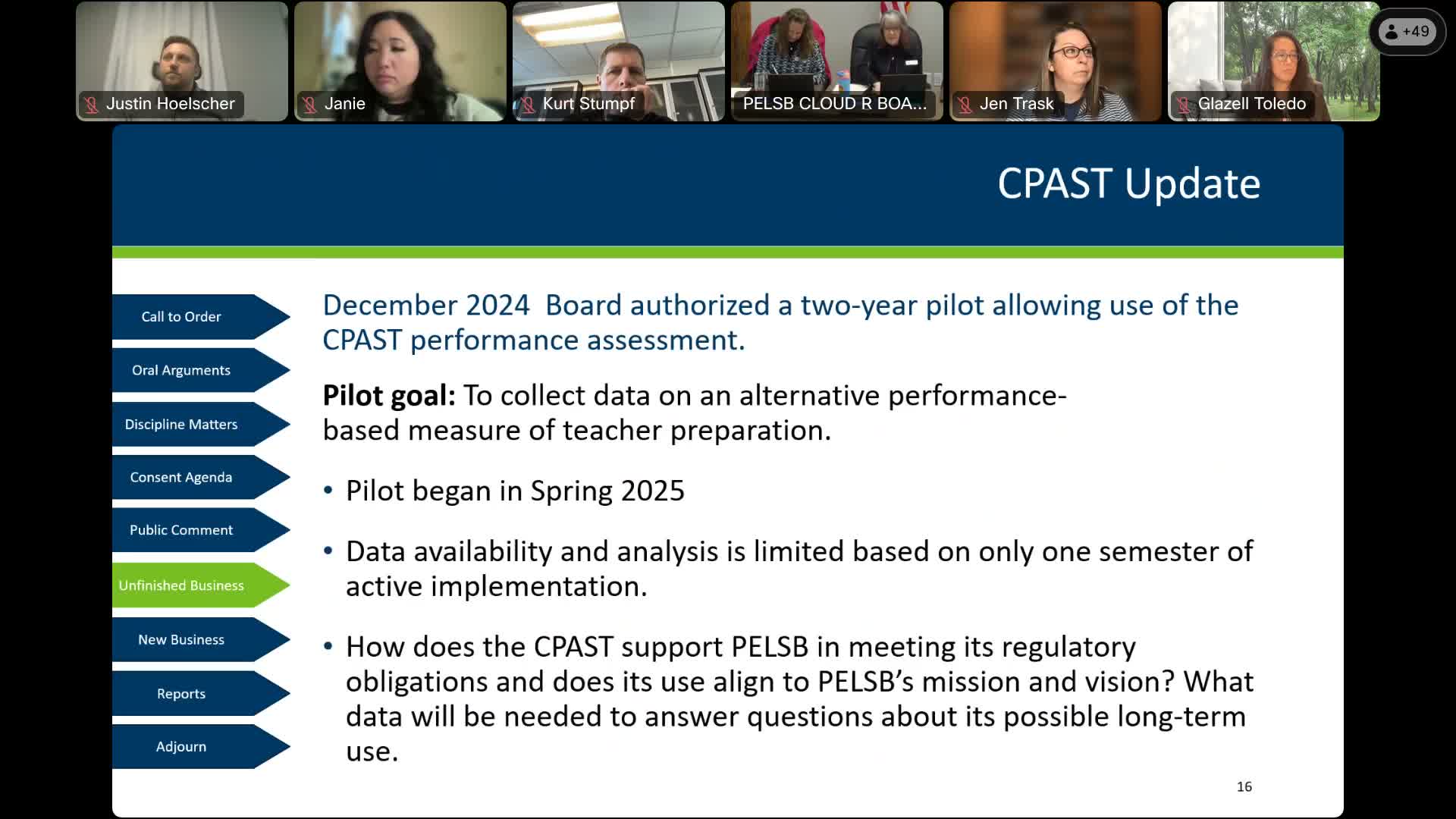
Erin Doan, the board’s Director of Educator Preparation and Pathways, said the board-approved two‑year pilot (authorized in Dec. 2024) has enrolled a majority of initial‑licensure providers and that staff have begun receiving self‑studies, PIRCA reports and other early data from participating institutions. Doan cautioned the board that data are limited at this stage but staff will ask providers for specific data during the spring term to evaluate CPAS's alignment with board standards and whether rubrics or additional data collection tools are needed.
Carla Stone, licensed program lead for the University of Minnesota’s Grow Your Own Teachers pathway for ESL and world‑language teachers, asked the board to grant a variance to permit locally determined summative assessments in place of the edTPA for ESL and world‑language candidates this spring. "A variance to allow students an alternative to the edTPA will give us the flexibility to design instruction and assessment that is more nimble and context specific than the edTPA affords," Stone said, citing student‑attendance volatility, safety concerns and disproportionate impacts on multilingual candidates.
Doan told the board CPAS is intended to be another measure in the board’s multiple-measures system and that staff will consider whether additional rubrics or data instruments are needed to compare candidate and cooperating‑teacher experiences between CPAS and edTPA. Board members asked that demographic breakdowns be available so the board can examine outcomes for candidates of color.
The board did not make a decision on the variance request at this meeting; Doan said staff are collecting data and will return with more analysis as the pilot continues.
Provenance: public comment and staff report recorded in the meeting transcript.