Get Full Government Meeting Transcripts, Videos, & Alerts Forever!
Get email alerts on the Graduation Dual Enrollment topic
No spam. Unsubscribe anytime.
Board debates tougher graduation requirements, dual‑enrollment limits and A/B course cycle to protect in‑house rigor
Summary
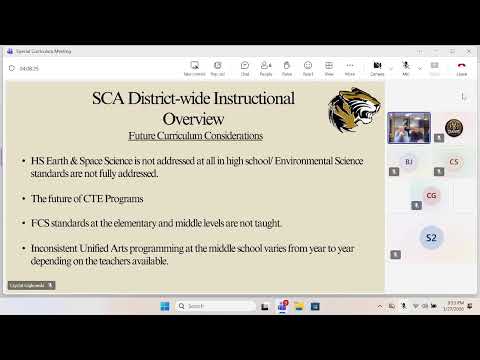
Administrators proposed requiring core graduation credits to be completed in‑house, raising science credits from three to four (to 23 total), and adopting an A/B rotating course schedule; board members pressed for enforceable dual‑enrollment criteria and improved scheduling optimization.
Board members and administrators spent the second half of the meeting focused on high‑school course sequencing, scheduling and dual‑enrollment controls.
High‑school staff argued the district should ensure core graduation requirements are completed in‑house and proposed increasing science graduation credits from three to four, which would raise the district credit requirement from 22 to 23. "All graduation requirements must be completed in‑house," an administrator presenting the recommendation said, framing dual enrollment as a supplemental option rather than a replacement for required coursework.
To address the chronic problem of small AP classes and unpredictable course offerings, the high school proposed an A/B year rotating schedule so students could reliably plan for AP or advanced courses on a multi‑year cycle. Staff said the change would support larger, more sustainable class sizes for courses that are run irregularly under the current master‑schedule approach.
Guidance and administrators described notable operational problems with some dual‑enrollment partners: colleges occasionally fail to provide coordinated rostering or timely add/drop information, resulting in students losing required credits and creating eligibility or athletic‑eligibility concerns. Guidance reported instances of students dropping college courses mid‑semester without notifying the district; administrators said partners often attributed the problem to understaffing.
Board members pressed for concrete policy changes. Suggestions included requiring students to complete specified in‑house courses before dual‑enrolling for graduation credit, tightening who qualifies for off‑campus enrollment (for example, juniors and seniors only, or minimum GPA/grade thresholds), daily or weekly self‑certification that students remain enrolled in college classes, and contract language with partner institutions to ensure roster transparency.
There was also a technical discussion about the district’s scheduling software (Sapphire) and whether the district should adopt optimization software that could iteratively reassign class times and teachers to maximize student requests. One board member urged the district to evaluate optimization tools rather than relying on manual master‑schedule construction.
Administrators told the board they will return in February with policy language and implementation steps tied to scheduling windows so any required staffing or software procurement can be timed for the next school year. No binding board vote occurred at the meeting; the discussion concluded with general consensus to pursue a detailed proposal and stakeholder survey.