Get Full Government Meeting Transcripts, Videos, & Alerts Forever!
Get email alerts on the School Finance topic
No spam. Unsubscribe anytime.
Northwest Area SD superintendent warns fund balance could be exhausted in 1–2 years, urges statewide advocacy
Summary
The district superintendent told residents the school faces a likely fund-balance depletion within one to two years amid rising transportation, debt service and cyber‑school costs, and urged community action and meetings with state lawmakers to seek relief and cyber-school cost caps.
Superintendent (title used consistently for the unnamed speaker) told residents that Northwest Area SD may exhaust its fund balance within one to two years unless state or federal aid arrives, and she urged constituents to press lawmakers for help.
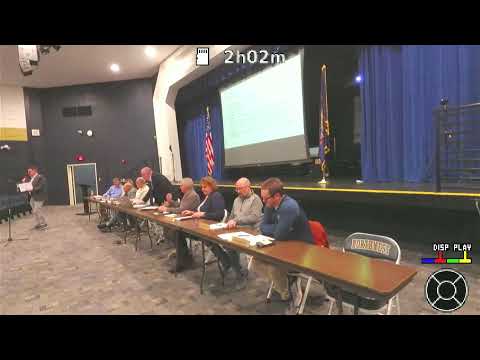
The superintendent opened an informational budget session by saying definitive answers are not yet possible because state funding figures remain unfinalized, but she laid out the district's fiscal picture: the district relies heavily on local homeowner taxes, has a limited commercial tax base, and has cut more than 20 teaching positions since 2010 (including five full‑time losses in the past five years). "We have cut to the bone," she said, adding that further reductions would directly affect student services.
She highlighted specific cost pressures: annual debt service on prior bonds of about $800,000 that cannot be refinanced due to current interest rates; transportation expenses that rise with district size and mileage; and special‑education transport costs the state does not include in special‑education subsidy calculations. "If we have a student that would have to go to the Scranton School for the Deaf, it is our responsibility to transport that child every day," she said.
A major line item, she said, is payments to outside cyber schools. The superintendent said roughly 50 students attend external cyber programs, costing the district more than $900,000 a year, with local taxpayers supplementing about $500,000 when state funding falls short. She contrasted the district's estimated cost to educate a student ($12,000–$13,000) with the state's per‑pupil payment (~$8,000) and said cyber providers charge between $16,000 and $40,000 per student — a gap the district currently covers from local revenue.
The superintendent described ongoing conversations with state lawmakers and education officials, naming Representative Jamie Walsh and meetings with senators and PDE staff, and said there is movement in Harrisburg to cap cyber‑school costs. She estimated that a cap could yield roughly $600,000 in relief for the district. "There is a lot of movement in Harrisburg to cap the cyber school cost at a certain rate," she said.
She also reviewed one‑time and federal supports: the district used about $2 million in ESSER funds for Chromebooks, curriculum and mental‑health supports and said that ESSER spending preserved about $1.3M–$1.4M of general‑fund dollars. A $320,000 grant for paving was described as restricted to that purpose. The superintendent estimated a year‑end fund balance of about $100,000 and said outstanding bonds are close to $6,000,000, with maturities around 2031.
To address the shortfall the district is pursuing several actions: forming a multi‑district rural coalition to advocate in Harrisburg (including planned events on April 16 and April 29), working with GLS Strategies to explore health‑care consortium savings and municipal lien collection to recoup unpaid taxes, reviewing benefits and purchasing practices, and operating a district virtual academy intended to bring students back from outside cyber providers.
She repeatedly framed the situation as urgent but not final: without additional funding the district could be designated a "distressed district," potentially face a state takeover, or be asked to consider a merger with another district. She described these as possible outcomes the district is trying to avoid through advocacy and cost‑management efforts.
Representative Jamie Walsh identified himself upon joining the meeting; the superintendent said he has met with district leaders and would be part of the outreach to appropriations leadership in April.
The superintendent said she will post the slide deck, advocacy points and a sample letter on the district app and website and provide an email address for residents to submit questions and sign up to contact lawmakers. The session was described as informational; no formal board actions or votes were recorded during the transcript.