Get Full Government Meeting Transcripts, Videos, & Alerts Forever!
Get email alerts on the School Budget topic
No spam. Unsubscribe anytime.
Mount Lebanon staff present balanced $125.1M 2025–26 budget; proposal includes Act 1 millage increase and special‑education exceptions
Summary
District staff proposed a $125,119,257 preliminary final budget for 2025–26 that they say is balanced without using fund balance; the proposal would raise millage to the Act 1 index plus approved special‑education exceptions and is projected to generate about $4.1 million in additional revenue.
Mount Lebanon School District staff presented a preliminary final budget for the 2025–26 school year that projects $125,119,257 in revenues and matching expenditures and, according to staff, does not rely on drawing down fund balance.
"The projected revenues for the 'twenty five-'twenty six budget are $125,119,257," Mrs. Connolly said during the district's April 7 budget forum. She told attendees the proposal reflects updated local revenue estimates and adjustments since the March base budget.
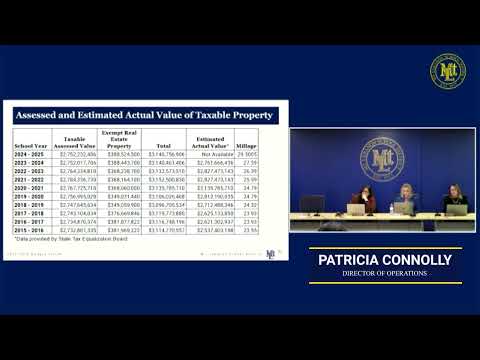
The presentation includes a proposed millage increase to the Act 1 index and the district's approved special‑education exceptions. Mrs. Connolly said the current millage is 29.3005 mills and that the combined increase would yield roughly $4.1 million in additional revenue. "If that average house was home value was $200,000 the taxpayer would be paying $27.49 more per month, or $329 more per year," she said as an illustrative example.
On expenditures, staff showed the preliminary final 2025–26 figure of $125,119,257 compared with an estimated final for 2024–25 of $121,232,917, an increase of approximately $3.9 million. Mrs. Connolly attributed changes since March to several factors, including a 5.7% increase in healthcare costs, modest increases for dental and vision, a lower projected salary base that reduced Social Security and retirement revenue, and a small number of positions left unfilled.
Staff also listed one‑time and ongoing items included in the proposal: a $665,677 purchase of new curriculum materials (ELA K–5, Science K–6, selected math resources) and approximately $119,000 of capital projects. Assumptions used in building the budget include a 3.5% salary increase, a certified PSERS employer contribution rate of 34% for 2025–26, and modest tuition and transportation contract increases.
District staff emphasized multi‑year planning. Mrs. Connolly presented a four‑year projection that begins with an expected 2024–25 deficit of about $204,000 that would be taken from fund balance, leaving unassigned balance near $1.9 million; she said budgets are projected to balance or produce surpluses thereafter under the stated assumptions.
On risk, staff highlighted rising pension and health‑insurance costs, potential interest‑rate movements, continued increases in transportation and tuition costs, commercial property tax appeals, and the uncertainty of some federal revenues. They also noted potential opportunities if the governor's budget increases state Basic and Special Education funding or if additional grants are secured.
Next steps: the presenters said the board will vote on the proposed final budget on April 21; the proposed final budget will be posted for 30 days and the board is scheduled to take the final adoption vote on May 21.
The district invited public comment and questions at the forum and thanked staff and budget managers for preparing the balanced proposal.