Get Full Government Meeting Transcripts, Videos, & Alerts Forever!
Get email alerts on the School Budget topic
No spam. Unsubscribe anytime.
Kutztown Area SD committee weighs 4% tax plan, special-education exemption and staffing cuts to close $155,000 gap
Summary
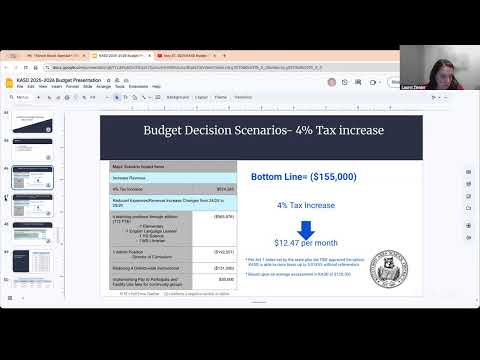
At a May 27 Budget & Finance Committee meeting, staff presented a 4% tax scenario that would leave a roughly $155,000 shortfall and a 5% Act 1 special-education exemption scenario that would produce a $67,597 surplus; trustees pressed for details on class sizes, redistribution of duties and a 5% scenario slide for next meeting.
Christian (staff member) told the Kutztown Area SD Budget & Finance Committee on May 27 that the district’s proposed final budget under a 4% tax increase would reduce the projected shortfall to about $155,000, a figure the board had approved earlier as the nonbinding proposed final budget.
Christian said using the Act 1 index plus a special-education exemption would add roughly $230,000 in revenue, erase the $155,000 deficit and leave an estimated $67,597 to go into fund balance. “You could with the additional revenue, which is a little bit, close to $230,000 … you then heat up that $155,000 deficit and there’s a 67,597 dollar surplus,” Christian said.
The staff presentation also flagged near-term adjustments that could help close the gap: posting of finalized assessed values (staff expects about $50,000 of additional local revenue largely tied to a recently sold building) and delaying a planned student van purchase (vehicle #14, which is nearing 200,000 miles) as a one-year deferral.
A trustee asked how the planned reductions would affect classrooms and services. Christian explained that the proposed final budget would reduce about four full-time equivalent teaching positions in upper elementary grades, eliminate one administration position (director of curriculum) and reduce some districtwide instructional-aide time. He described how administrators would redistribute curriculum, ELL and technology oversight among existing staff and use a bilingual instructional aide to cover some ELL duties rather than immediately refilling roles.
“I’m sure you wouldn’t put this forward if you don’t think that we can handle that reduction,” a trustee said, asking specifically how the eliminated positions would be absorbed. Christian replied that schedules will be adjusted (class periods, use of certified ESL teachers, redeploying an eighth-grade teaching position to coordinate interventions and library oversight) and that staff have tried to avoid eliminating individual positions where possible.
Trustees raised concerns about class size and student support. One trustee asked for a comparison of projected average, high and low elementary class sizes versus five years ago; Christian said five years ago average class size was typically about 18–20 students, while the upper elementary grades under the proposed reductions could see averages near or above 25. “I think students today are under more stress and have more learning challenges coming out of the pandemic,” the trustee said, urging caution about larger class sizes.
A trustee urged the board to accept the special-education exemption if the district qualifies, noting it would set aside revenue for upcoming elementary-school improvements and reduce reliance on bond issuance. “I’m just of the opinion that we qualify for the special education, Act 1 index,” the trustee said.
Christian said staff will present additional scenarios at upcoming meetings, including a request from a trustee to show a 5% tax scenario that would reinstate an elementary teaching position; he indicated that a 5% levy combined with delaying the van purchase would essentially fund one teaching position. Christian also scheduled a follow-up update on pay-to-participate athletics for the June 2 meeting but said he did not anticipate a substantial change to the budget bottom line from that item.
The committee agreed to consider board action at the next meeting; Christian recommended canceling the June 16 meeting unless additional discussion is needed after June 2. The meeting ended with a motion to adjourn that was moved and seconded; no vote tally was recorded in the transcript.
What’s next: staff will post final local assessed values when available, present a 5%-levy scenario and give the June 2 update on pay-to-participate fees before the committee finalizes the district’s proposed final budget.