Get Full Government Meeting Transcripts, Videos, & Alerts Forever!
Get email alerts on the Budget topic
No spam. Unsubscribe anytime.
Bermudian Springs board adopts 2024–25 budget after debate on taxes and vo‑tech funding
Summary
The Bermudian Springs School Board voted to adopt the 2024–25 general fund budget under option A (3.6%). Board member Ruth Griffey urged allocating 2% of the increase toward exploring a vocational-technical (vo‑tech) program in Adams County; the motion carried after roll-call votes.
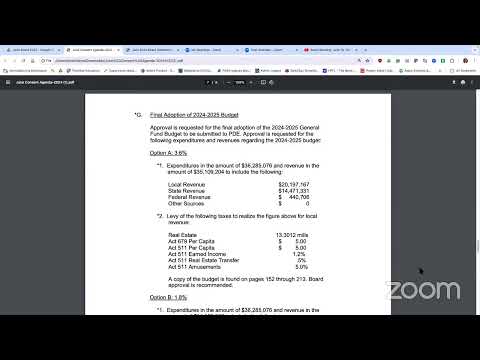
The Bermudian Springs School Board on a roll-call vote adopted the 2024–25 general fund budget under option A (3.6%). Board members voted in favor of both parts of option A after a period of discussion about tax impacts and program priorities.
Board member Ruth Griffey framed her remarks around the district’s recent tax-index history and fiscal restraint, saying that ‘‘college is not for everybody and cannot be afforded by some’’ and urging support for career-technical training: ‘‘I would like that 2% of the 3.6 tax increase will be allocated to seeking [a] VOTEC school in Adams County by the ACI.’’ Her statement asked the board to earmark a portion of the increase to pursue a vocational-technical option and encouraged private donations to offset costs.
The chair introduced three options for the final budget and explained that votes on parts 1 and 2 of option A needed to be consistent. After the board held roll-call votes on both parts — each recorded as carried — the chair announced that the 2024–25 budget would be adopted under option A (3.6). The motions were made, seconded and approved by roll call.
Why it matters: adoption of the budget sets the district’s tax and spending plan for the coming school year and authorizes submissions to the Pennsylvania Department of Education. The small but specific proposal to direct a portion of the tax increase toward exploring a vo‑tech program signals a board interest in expanding career-technical pathways for students who do not pursue four‑year college degrees.
The board did not record a detailed funding breakdown in discussion beyond Griffey’s request to allocate 2% of the approved increase to vo‑tech exploration. The board’s next procedural steps include implementation of the adopted budget and any administrative follow-up to the vo‑tech exploration request.
The board concluded the budget votes and moved on to subsequent agenda items.