Get Full Government Meeting Transcripts, Videos, & Alerts Forever!
Get email alerts on the Meeting Governance topic
No spam. Unsubscribe anytime.
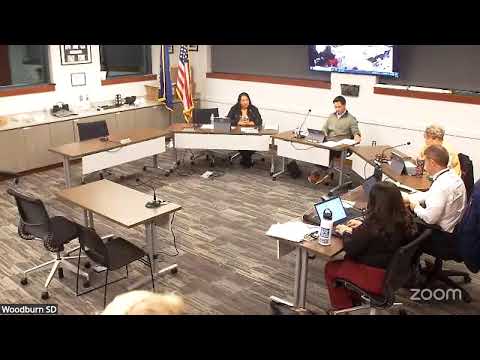
OSBA trainer urges Woodburn School District board to use tighter agendas, clear public‑comment rules
Summary
At a special Woodburn School District Board meeting, OSBA trainer Vince Adams urged clearer agenda planning, time limits and consistent enforcement of public‑comment rules, arguing that meeting structure shapes board culture and student outcomes. The board later entered executive session.
Vince Adams, a presenter from the Oregon School Boards Association, told the Woodburn School District Board of Directors on Monday that how a board runs its meetings shapes its culture and, ultimately, classroom outcomes. Adams praised the board’s early procedural clarity and walked through agenda planning, parliamentary practice, and public‑comment policies used to preserve fairness and efficiency.
Adams said boards should plan agendas collaboratively — typically involving the chair, superintendent, administrative professional and either the vice chair or a rotating member — and suggested publishing a timed agenda well in advance so staff and the public know what to expect. He recommended a seven‑day packet lead time and using tools such as BoardBook to capture notes as public records.
The OSBA presenter reviewed meeting mechanics — main motions, seconds, restating amended motions, and recording votes — and recommended procedural tools to increase inclusion, such as a two‑time round‑robin (everyone speaks once before any second turns) and speaking charts to track movers, seconders and vote tallies. “A school board meeting is a meeting of the school board in public. We meet in the public, not with the public,” Adams said, urging clear limits on public participation that protect free‑speech rights while preserving order.
On public comment, Adams advocated announcing time, place and manner rules on the agenda and enforcing them consistently to avoid viewpoint discrimination. He described a common approach of allowing three minutes per speaker and a total public‑comment window (for example, 30 minutes) but noted districts may adjust duration when turnout is expected to be large. He also urged boards to avoid converting public comment into on‑the‑spot debate, instead recommending follow‑up after the meeting to “close the loop.”
Adams cautioned that constraining speech about staff or students can raise legal risk unless the board’s policy clearly authorizes such limits; he told the board to consult district counsel on edge cases and to adopt clear policy language if the board intends to restrict comments about identifiable staff or students. “When in doubt, let them speak,” he said, while also advising that chairs interrupt speakers who violate narrowly defined unprotected categories such as true threats, incitement or defamation.
The presentation included practical suggestions to keep meetings efficient — use timed agenda items, avoid overloading a single meeting, sequence staff reports so principals and families can leave earlier, and use work sessions for in‑depth or nonlinear learning. Adams urged the board to screen agenda items against its strategic plan so meeting time advances the district’s stated priorities.
Board members asked clarifying questions during the presentation about policy language, public‑comment sign‑ups and enforcement. Adams said OSBA would provide the board with a free‑speech guide and other materials he referenced during the training.
The board recessed to an executive session later in the meeting; the session’s ORS citations were read aloud by the chair before the recess.