Get Full Government Meeting Transcripts, Videos, & Alerts Forever!
Get email alerts on the State Budget topic
No spam. Unsubscribe anytime.
3 Rivers superintendent warns of possible mid‑biennium state cuts, urges advocacy day
Summary
Superintendent Valenzuela told the board that a weakening state revenue forecast could shrink the state school fund mid‑biennium; he urged attendance at Education Advocacy Day on Feb. 17 and outlined district enrollment and virtual‑academy revenue figures that would matter if cuts occur.
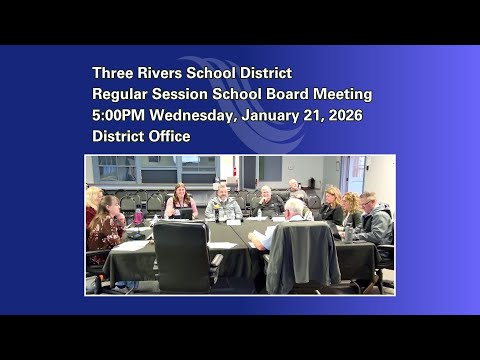
Superintendent Valenzuela warned the Three Rivers School District board on Jan. 21 that a weaker state revenue forecast could prompt a mid‑biennium reduction to the state school fund and urged board members to attend Education Advocacy Day in Salem on Feb. 17 to press legislators to protect K‑12 budgets.
Valenzuela said the September revenue forecast showed a $1,000,000,000 shortfall that was later revised to about $600,000,000, and that those swings had prompted state officials to ask districts to prepare for potential cuts. "When the biennium closed up ... the state revenue forecast was down $1,000,000,000," he said. "Since then ... the December forecast lowered that deficit to $600,000,000." He added that forecasts due Feb. 4 could change the outlook again.
The superintendent placed the risks in concrete district terms. He told the board the district's general‑purpose funding per student is $11,074, and that average daily membership rose from 5,286 to 5,418 (an increase of 132 students). "That equates to ... $1,461,768," he said. Valenzuela also outlined enrollment in the Applegate Valley Virtual Academy (AVA): "As of January 2026, 387 students in AVA ... equivalent to $4,285,000," he said, and noted the district initially retains 15% of that amount — about $642,845.
Valenzuela described those funds as "future proofing" but cautioned they are not guaranteed if the state reduces the school fund mid‑biennium. He urged board members to participate in Education Advocacy Day so local officials can explain real‑world impacts, saying the event involves brief visits with legislators across the Capitol to make the district’s case.
Board members asked how quickly cuts could take effect and what measures districts might take; Valenzuela said a worst‑case scenario could include cutting school days or staff, citing an earlier episode in 2001 when Monday classes were canceled to balance budgets. He and other board members said they believe lawmakers want to protect K‑12 funding but noted it is prudent to advocate in person.
The board did not take action at the meeting beyond endorsing member participation in advocacy; Valenzuela and staff offered to supply legislators with district data should members attend.