Get Full Government Meeting Transcripts, Videos, & Alerts Forever!
Get email alerts on the Assessments topic
No spam. Unsubscribe anytime.
Pleasant Hill SD 1 hears STAR assessment results showing mixed projections and plans for targeted support
Summary
Instructional coach Stephanie Lobdawkins told the board that nearly the entire district took new STAR assessments this fall, with 60.4% of students at or above the district benchmark but lower projected proficiency on some state-aligned measures; the district will test three times a year and use results for targeted interventions and dyslexia screening.
Stephanie Lobdawkins, the district instructional coach, presented the Pleasant Hill SD 1 board with the district’s first full-year results from STAR assessments and outlined how the data will be used to guide instruction and interventions.
Lobdawkins said the district had tested nearly all students this fall (about 187 students versus a 21-student spring pilot) and that STAR aligns to Oregon standards and provides immediate, computer-adaptive results. "So district wide, 60.4 percent of students are at or above district benchmark in the fall," she told the board, adding that first grade showed the highest percentage at 75 percent at or above benchmark.
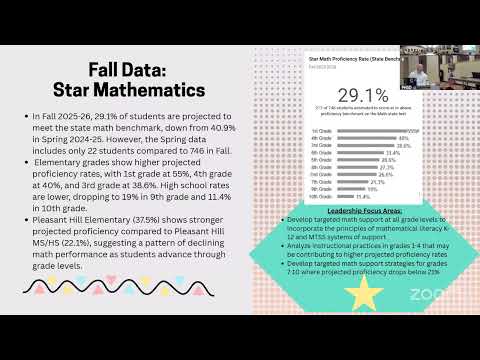
The presentation distinguished different measures and sample-size effects. Lobdawkins highlighted fall reading projections of 56.5 percent meeting state-reading benchmarks and a MAP projection of 29.1 percent expected to meet state benchmarks; she cautioned that spring comparisons are affected by the pilot’s small sample (21 students) and argued the STAR rollout will give the district more comprehensive, longitudinal data.
Lobdawkins explained how STAR supports instruction: it provides lesson-path recommendations, small-group and individual intervention pathways, progress monitoring and a dyslexia screener for kindergarten and students below the twentieth percentile in compliance with new state screening requirements. "We’re going to test three times a year," she said, noting tests will be given in the fall, January and May to guide mid-year adjustments and end-of-year grading.
Board members asked for clarification about what "proficiency" denotes and how the district will use results to target professional development. Lobdawkins said the district will set instructional goals, form targeted small groups and develop training for teachers and special-education staff to ensure students with IEPs receive appropriate assessments and accommodations.
The presentation also flagged areas for targeted support: middle grades showed projected proficiency between roughly 50 and 55 percent; high school projections were lower (about 19 percent for ninth grade and 11.4 percent for tenth grade), indicating a need for math literacy work across grades 7–10. Lobdawkins said leadership will prioritize first-grade instructional practices and kindergarten supports and will work with middle and high school staff on mathematical literacy.
Next steps the district outlined include publishing a districtwide assessment calendar aligned with the state schedule, weekly participation tracking during testing windows, training for building test coordinators and post-testing debriefs to verify participation and accommodations for students with disabilities. The board did not take a policy vote on the presentation itself; staff said corrective-action steps tied to state assessment compliance appear elsewhere on the agenda.