Get Full Government Meeting Transcripts, Videos, & Alerts Forever!
Get email alerts on the Academic Data topic
No spam. Unsubscribe anytime.
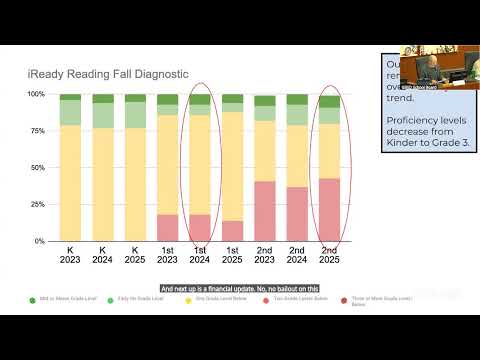
District presents fall 2025 diagnostics: literacy flat, math progress limited; gaps for EML and students with IEPs persist
Summary
District staff presented fall 2025 I‑Ready and STAR diagnostics showing relatively flat year‑to‑year starting points, persistent achievement gaps for emerging multilingual learners and students with IEPs, and early‑year declines that suggest summer learning loss; staff outlined literacy labs, math strategies and a district capacity assessment.
District staff presented the fall 2025 academic benchmarks and diagnostic data and highlighted both steady areas and ongoing gaps.
Presenters said elementary and middle‑school fall diagnostics (I‑Ready and STAR) show relatively flat starting points over a three‑year span, with modest gains in some cohorts but persistent gaps for students who are emerging multilingual learners (EML) and students with IEPs. At the elementary level, staff noted stronger decoding skills than comprehension overall and described targeted literacy strategies such as short PD labs, partner‑reading routines and differentiated decodable texts.
On math, staff said growth is more limited: middle‑school and high‑school math measures remain fairly flat, prompting targeted interventions. District staff highlighted efforts to align math instruction across grade levels ("building thinking classrooms"), increase co‑planning and co‑teaching, and provide high‑school scheduling that adds time for remediation when needed.
Speakers also raised concerns about kindergarten readiness and summer learning loss. Board Chair Blake Peterson and others emphasized that much of the challenge stems from community‑level supports and that the district’s approach must combine classroom strategies with broader community engagement.
Why it matters: The data frame priorities for the coming instructional year as the district seeks to close persistent subgroup gaps and address foundational skills disrupted during the pandemic. Staff presented a district capacity assessment showing implementation progress and noted that staff will continue to monitor growth and present updates.
Next steps: The district will focus on growth measures in subsequent reporting cycles, continue literacy and math professional development, and pursue targeted school improvement work for middle and high schools.