Get Full Government Meeting Transcripts, Videos, & Alerts Forever!
Get email alerts on the District Budget topic
No spam. Unsubscribe anytime.
Gresham-Barlow officials outline $7.5M–$13M gap and ask community to weigh priorities
Summary
District leaders told a public forum they face rising PERS, utility and insurance costs, steady enrollment declines and flat federal grants, projecting $7.5 million to $13 million in new reductions (on top of about $8 million already cut) and asking the public to help prioritize choices via a survey open through Feb. 17.
Gresham-Barlow School District officials told residents at a budget forum that the district faces a sizable funding gap driven by rising retirement (PERS) and operating costs, declining student enrollment and flat federal grants.
Pete Bejarano, the district's director of finance, said most general fund revenue comes from the State School Fund, with roughly 22% from local property taxes and 8% from other sources. He said payroll accounts for nearly 70% of spending and that cost categories outside the district's control are growing faster than revenue: "Our PERS costs are increasing much, much more than that 4% — it's closer to 10% actually," Bejarano said. He also cited utility increases around 9% and insurance cost jumps of about 12% in one year.
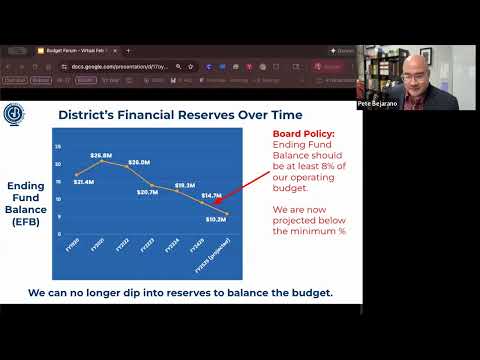
Bejarano said reserves—ending fund balance and contingency—are projected at about $10.2 million for the current fiscal year, which he said puts the district below its board policy target of at least 8% of operating budget. "We can't dip into reserves to keep balancing the budget, and that's part of why we're here today," he said.
The finance director presented a projected reduction range of $7.5 million to $13 million for the coming year on top of roughly $8 million already cut this year, for total reductions of about $15 million to $21 million, which Bejarano described as "approximately 6% of our overall general fund budget."
Superintendent Tracy Klinger said the district is using a decision tool and a set of guiding principles—legal requirements, instructional priorities, safety and equity impacts—to evaluate possible reductions. Klinger urged community members to complete the district survey, which officials said is being distributed to staff and families and closes Feb. 17, so the district can consider public priorities when finalizing options.
Klinger outlined short-term and longer-term advocacy goals. In the short term she recommended constituents contact state legislators about using Oregon's education stability fund to mitigate cuts; she said longer-term priorities include adjustments to the way special education and high-cost disability services are funded.
On personnel, Michael Squeaton, the district's executive director of human resources, described the timeline for temporary employee notices: district practice is to issue notice on March 15 and provide an April 15 window for intent-to-return communications, with a goal of informing staff by April–May while honoring collective bargaining agreements and seniority lists.
Officials said some common cost-saving options have limited impact. Klinger said furlough days are a short-term measure and "not gonna be a solution that's sustainable for us as a district" given the long-term pressures from PERS and other fixed costs. Early retirement packages are not part of current plans.
The forum closed with a preview of the formal budget process: staff will prepare a proposed budget, the budget committee (the school board plus community members) will review proposals in March and April, and the school board must adopt a budget by June 30. Klinger said the district will be strategic about publicly listing potential district-level reductions to avoid inadvertently identifying staff positions while still providing opportunities for community input.
Next procedural steps: the district will review survey responses and finalize reduction scenarios during the March–April budget committee and school board meetings.