Get Full Government Meeting Transcripts, Videos, & Alerts Forever!
Get email alerts on the Special Education topic
No spam. Unsubscribe anytime.
Pickerington Local launches Empower Ed series explaining special-education process
Summary
Interim special-education director Lisonbee Zweifel outlined how referrals, evaluations and individualized education programs (IEPs) work in Pickerington Local Schools, including 30- and 60-day timelines, the least-restrictive-environment continuum and resources for families.
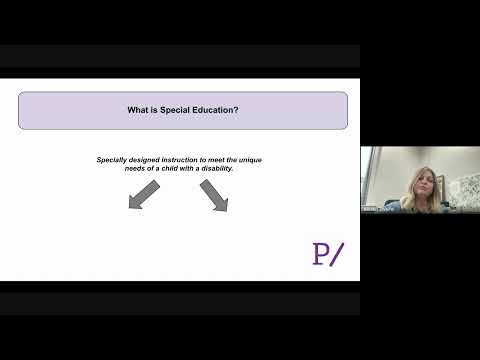
Lisonbee Zweifel, interim special-education director for Pickerington Local Schools, opened the district’s first Empower Ed webinar with a step‑by‑step overview of how families can request and receive special-education services.
“Special education is a service. It is not a place,” Zweifel said, stressing that supports are individualized so students can access the general curriculum.
Why it matters: Zweifel framed the presentation as a resource for families to understand rights, timelines and team roles under the Individuals with Disabilities Education Act (IDEA). She said the district serves about 2,000 students identified under IDEA and urged families to participate in IEP team meetings as equal partners.
How the process starts: A referral — usually from a parent, teacher or staff member — initiates consideration for evaluation. Zweifel said the district has 30 days to respond to an official request and that, if the district does not suspect a disability, it will notify families in writing and explain the decision.
Evaluation and eligibility: If the team proceeds, staff hold a planning meeting to obtain parent consent and determine needed assessments. Results are discussed in an evaluation team report (ETR) meeting that decides eligibility. Zweifel said the district’s timeline from consent to eligibility determination can take up to 60 days, though teams often complete work sooner.
IEP development and LRE: If a child qualifies, the IEP team — which must include the parent — drafts goals, accommodations and placement. Zweifel explained the least‑restrictive‑environment continuum (from general education through resource rooms to more specialized settings) and said the district’s goal is to serve students in the least restrictive setting appropriate.
Progress, annual review and parental role: Zweifel outlined annual-review topics — progress on goals, changing needs, services and accommodations — and said parents may request an IEP meeting at any time. She advised parents to bring observations, medical reports or other documents and to prepare a clear list of concerns and a vision for the child’s goals.
Communication and supports: To help teams collaborate, Zweifel recommended families and teachers set a communication plan, identify a teacher of record (TOR) to coordinate services and assume positive intent in interactions. She noted that health services (nurses) and related providers (speech, occupational and physical therapy, vision/hearing specialists, school psychologists) are part of Student Services.
Resources and next steps: Malika Jefferson, introduced as the interim executive director of student services, was listed as the chat responder and was to post links to the student-services web page, special-education timelines and family resources. Zweifel asked attendees to complete a pre‑ and post‑survey and said the Empower Ed series will run monthly.
What the district said vs. what it didn’t: Zweifel provided concrete timelines and procedural steps; she did not offer case‑level guarantees about specific placements or outcomes, noting eligibility depends on team determinations and the individual student’s needs.
The session closed with a reminder that special education is a legal right provided at no cost to families and an invitation to contact Student Services with further questions.