Get Full Government Meeting Transcripts, Videos, & Alerts Forever!
Get email alerts on the District Finance topic
No spam. Unsubscribe anytime.
Pickerington board narrows focus to income‑tax option, asks staff to prepare 1.25% and 1.5% resolutions
Summary
The Pickerington Schools Board heard a five‑year forecast showing multi‑million‑dollar deficits and discussed property‑tax and income‑tax options; the board directed administrators to prepare both 1.25% and 1.5% income‑tax resolutions for next week to meet a Feb. 4 filing deadline.
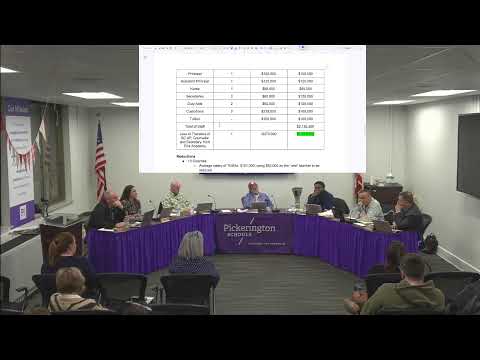
The Pickerington Schools Board of Education on Jan. 12 reviewed a multi‑year financial forecast showing the district could face a substantial cash shortfall by 2030 and directed staff to prepare ballot paperwork for local income‑tax options. Administrators said legislative changes to Ohio tax law and recent staffing needs have combined to widen the district’s projected deficit.
Mister Walsh, presenting the forecast, said the district’s most recent projection showed a multi‑year gap that could produce a negative cash balance in later years. “When we get out to 2030, we have a projected negative cash of $44,000,000,” Mister Walsh said, summarizing the district’s October forecast and the post‑October adjustments.
Why it matters: the board has a policy target of maintaining at least 45 days of operating cash. Walsh said the district ended FY25 at about 52 days but expects to fall below policy in subsequent years unless the board adopts new revenue or cuts expenditures. He estimated the combined effect of added staffing and anticipated legislative tax changes could reduce revenue by about $5.11 million and add roughly $3.62 million in staffing costs over the forecast window.
Board members reviewed three property‑tax scenarios (11.3, 10.7 and 9.97 mills) and two income‑tax scenarios (1.25% and 1.5%). Walsh said an 11.3‑mill property levy would amount to roughly $395.50 per $100,000 of assessed value per year and would restore the board’s 45‑day cash target through 2030 under current assumptions. He cautioned that property levies tend to collect faster (about 50% in the first fiscal year) while income‑tax revenue ramps over about three years.
After debate about class sizes, voter support and which rate to seek, the board chair, Kathy Olszewski, asked staff to prepare both a 1.25% and a 1.5% income‑tax resolution for the next board meeting. “Bring both resolutions to the board next week,” Olszewski said, noting the filing deadlines. The chair also reminded members that a board vote to proceed requires a supermajority (at least 4–1).
Several board members favored an income tax over a property levy. One member said an income tax would “help alleviate some of the pressure on some of our citizens” by not taxing Social Security in a traditional form of the tax; another said the district should focus on what rate voters would accept to avoid repeated trips to the ballot.
Administrators described non‑revenue options they had vetted if voters reject a levy, including transportation reductions (for example, eliminating routine high‑school busing or changing routes), limiting extracurricular transportation, raising participation fees, larger class sizes, and delaying some curriculum purchases. Those changes were presented as contingencies, not firm actions.
Next steps: the board did not take a final vote on revenue measures at the Jan. 12 work session because the meeting was informational and procedural rules prevent final actions at a work session. Administrators said they will prepare the paperwork and a corrective‑action timetable so the board can consider formal resolutions and, if approved by the required majority, file with the appropriate county and state offices before the Feb. 4 deadline to appear on the May ballot.