Get Full Government Meeting Transcripts, Videos, & Alerts Forever!
Get email alerts on the Education Exec Functions topic
No spam. Unsubscribe anytime.
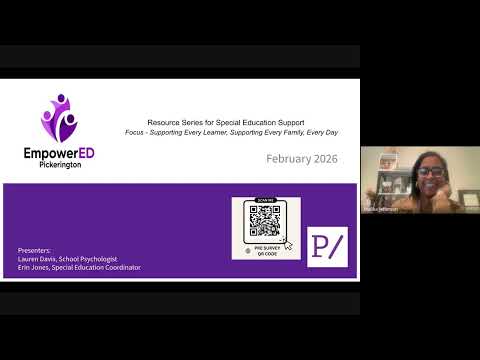
Pickerington Local holds webinar on executive functioning, offers classroom and home strategies
Summary
Pickerington Local School District hosted an online Empower Ed presentation explaining executive functions, describing how schools identify students through MTSS, and outlining classroom and home strategies; presenters said resources (an "Executive Functioning 101" packet and Harvard materials) are available by email.
Pickerington Local School District hosted a virtual Empower Ed presentation for families and community members that explained executive functioning skills, how schools identify students who need extra supports, and practical classroom and home strategies to help students succeed.
Erin Jones, a special education coordinator who works at Hillgate Elementary and Pickerington Elementary, told attendees that "executive functions involve everything that you do all day long" and listed core skills including organization, planning and prioritizing, task initiation and completion, working memory, self-monitoring, flexibility, emotional control and impulse inhibition. Jones cited Harvard research to describe typical developmental growth — "children struggle with one or more areas of executive functioning" — and emphasized variability among students.
Lauren Davis, a school psychologist introduced by Jones, described the district's approach to identifying students through multi-tiered systems of support (MTSS). Davis said teachers bring observations, behavior referrals and progress-monitoring data to intervention teams, which then decide whether to intensify supports or pursue additional standardized tools. To illustrate how needs appear across a day, Davis presented a composite example of a sixth-grade student, "Josh," who repeatedly forgets items, misses steps on multi-part tasks and ends up working late to finish assignments, showing how multiple executive-function deficits can compound.
Both presenters offered concrete strategies teachers and families can use. In the classroom they recommended clearer presentation of material, highlighted keywords, step-by-step scaffolding, use of checklists and rubrics, simplified page layouts and accommodations such as rotated paper or graph paper for math. They urged giving students extra wait time after instructions and called for consistent routines and explicit expectations: "Short, simple phrases with a visual can be very helpful," Jones said. For behavior regulation they suggested tailored breaks, sensory "heavy work" when appropriate, and monitoring to avoid giving students breaks that overstimulate them.
On supports for working memory and task completion, presenters recommended external tools (calendars, phone reminders, checklists), breaking multi-step work into smaller parts, and teacher-led progress monitoring to determine whether interventions are effective. Davis stressed that teams should view additional formal assessments only after MTSS steps have been tried and documented.
The presenters said the materials come from an "Executive Functioning 101" packet used by the district and from Harvard education resources; Jones invited attendees to email her, Davis or district directors to request copies. The session closed with brief participant remarks and thanks.
The webinar was informational; no formal district decisions or votes were recorded during the presentation. Attendees were offered follow-up materials and contact information for the presenters.