Get Full Government Meeting Transcripts, Videos, & Alerts Forever!
Get email alerts on the Budget Finance topic
No spam. Unsubscribe anytime.
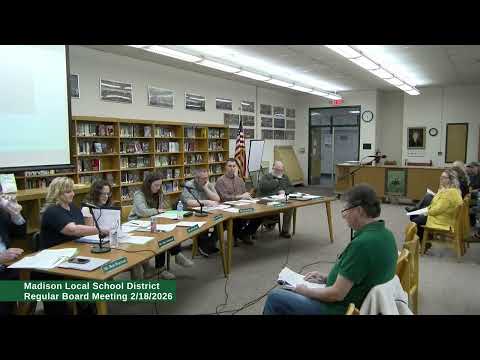
Treasurer: Madison Local reports negative cash days, warns cuts likely if levy fails
Summary
The district treasurer told the board that January closed with a negative seven days of cash on hand and that a $146,000 reduction tied to county tax "piggybacking" plus flat state aid mean the district will need new local revenue or further cuts; a May levy is on the ballot.
The Madison Local School District—s treasurer told the school board that the district ended January with "a negative 7 days cash on hand in the general fund," and warned that continued flat state funding and recent county changes to homestead/owner-occupied tax reimbursements are squeezing local revenues.
"We did end up finishing January with a negative 7 days cash on hand in the general fund," the treasurer (S4) said, explaining the district borrowed internally from non-operating funds and took two advances on real-estate settlements to manage short-term cash flow. He said those advances made January—s revenues appear higher but do not change underlying fiscal pressure.
Why it matters: The treasurer told the board the district relies on state foundation payments (about 51% of revenues) and local property taxes (about 41%), and that recent actions by county commissioners to "piggyback" the owner-occupied rollback will reduce district collections by roughly $146,000. "The state, by keeping us flat, is pushing the burden to all the taxpayers," he said, adding that without new local revenue the district will need further reductions in spending or staff.
The treasurer presented a revised five-year forecast showing only minor variance from the October projection but stressed the forecast is sensitive to timing and policy changes. He flagged benefits, especially health insurance, as a major cost driver ("health insurance right now is 65% of our benefits"), and said salaries and benefits represent roughly 85% of expenditures.
Board actions and next steps: The treasurer asked the board to approve the updated five-year forecast and matching budget modifications; those items were placed before the board with a motion for approval. He also noted the district will appear on the May ballot for a revenue levy and said, "we're going to have to continue to make cuts if we don't get more revenue." The board voted to approve the forecast and related budget modifications on the record during the meeting.
Context: The treasurer described the use of two advances on real-estate settlements as a cash-flow measure that skewed January—s revenues upward for the month but left the district with fewer days of operating cash on hand. He also described efforts to control costs through consortiums for insurance, energy, and fuel purchases and other operational measures.
What follows: The board agreed to monitor the district—s forecast and come back with an update before the fiscal-year end; the treasurer said a subsequent public forecast update would be provided in late spring.