Get Full Government Meeting Transcripts, Videos, & Alerts Forever!
Get email alerts on the Education School Programs topic
No spam. Unsubscribe anytime.
School 14 highlights test‑score gains, expands I‑Ready use and mentoring program
Summary
School 14 principal presented multi‑year gains on New York State tests, set an equity goal for English learners tied to I‑Ready, and described new and expanding supports including UFLI phonics, a Stronger Connections mentoring program (24 mentors, 132 scholars) and family‑engagement events.
School 14 presented district leaders and board members with a data summary and several new instructional and family‑engagement initiatives, saying the programs aim to accelerate achievement for students who are not yet meeting grade‑level standards.
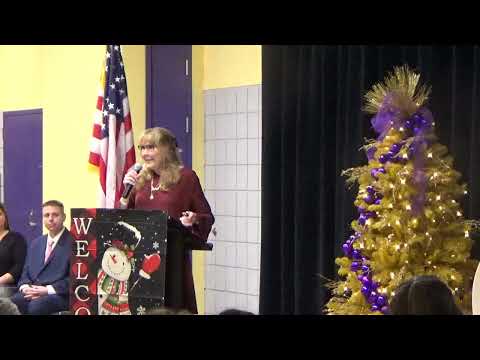
The principal opened the presentation by thanking the Board of Education and district leadership and outlining three parts: a data overview, an I‑Ready demonstration by David Rossi, and family‑engagement highlights from Jenna Gurn. The principal said the school’s ELA trend shows an 11% gain in third grade and that multi‑year math trends remain positive despite a small recent dip. "We know which ones we did well in and which ones are areas of growth for us," the principal said, identifying central idea/summarizing in ELA and number and operations in base‑10 (including decimals) in math as the key growth areas.
The principal framed the work under the district’s theory of action and set an equity goal tied to I‑Ready: "Our equity goal for this year, we commit by June 2025 that 50% of our transitioning and expanding English language learner students will accelerate their learning as evidenced by meeting their stretch growth benchmark goal in I Ready," the principal said. She noted School 14 currently has 72 English learners and described targeted small‑group instruction, ELL data profiles, professional development on scaffolding and language development, and mentor assignments through a grant‑funded Stronger Connections program.
David Rossi described how the i‑Ready platform is used at the school. "The diagnostic is adaptive based on how students are answering questions," Rossi said, adding that the tool produces groupings and lesson recommendations teachers can use for differentiated instruction. Rossi said the district expects students to spend about 45 minutes per week on I‑Ready in ELA and 45 minutes in math to maximize learning and shared several student examples showing gains between the diagnostic and standards‑mastery assessments (for example, a fourth‑grade student improving from 46% to 67% after targeted lessons).
Jenna Gurn, who chairs the school’s family‑engagement committee, highlighted several events that drew large family participation. She said the school’s first LEGO Masters event attracted more than 80 families, the Fall Family Fest drew over 600 attendees with community partners including CDPHP, and the Turkey Trot saw a 32% increase in family attendance from prior years. "These events could not take place without board teams and dedicated staff," Gurn said, thanking volunteers and staff.
The presentation also covered literacy programs: the University of Florida Literacy Institute (UFLI) phonics curriculum is used for grades 1–2 and will be extended to kindergarten tier‑3 scholars in January; "Morpheme Magic" was cited as the vocabulary program for grades 4–5. The principal said the school is conducting triweekly ELA assessments for grades 3–5 (grades 4–5 on computer this year; grade 3 still paper but moving to computer next year) and has expanded after‑school academic blocks that include small‑group homework help, independent reading, and I‑Ready time.
The presentation closed with a short student video produced by a fourth‑grade teacher. The board offered applause and moved on to routine business.
Next steps: the principal and presenters framed the I‑Ready implementation as an early phase of work; the school will continue to report progress to the board and monitor whether the equity goal for ELL students is met by June 2025.