Get Full Government Meeting Transcripts, Videos, & Alerts Forever!
Get email alerts on the Budget topic
No spam. Unsubscribe anytime.
Rondout budget preview: district projects roughly $5 million shortfall as state aid ratios fall
Summary
Officials told the board a preliminary 2025–26 budget projects an approximate $5 million gap driven by lower aid ratios and constrained tax‑levy growth; transportation and BOCES aid decreases were singled out as contributors.
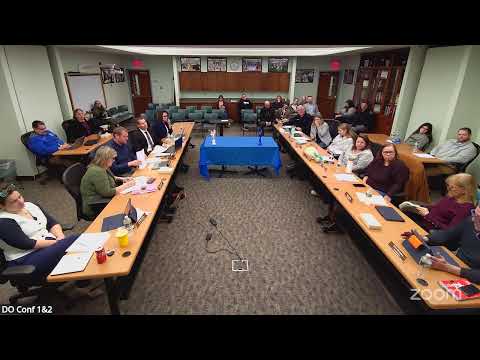
District finance staff gave a budget preview at the Feb. 11 board meeting that laid out the preliminary numbers and a range of pressures the district faces for the 2025–26 budget year.
The official presenting the budget said the district’s projected expenditure increase for the coming year is about 2.2%—roughly $1.7 million—while several preliminary revenue lines and adjustments produce a shortfall the presenter estimated at about $5 million that the board must address. He highlighted mechanics of state aid calculations and illustrated how shifts in assessed values and the resident weighted average daily attendance (RWADA) affect aid ratios.
"At 2425, our aid ratio ... is about 31¢ on the dollar; in 2526 we're only gonna get 18¢ on the dollar for an expense," the presenter said, explaining that some categories of aid (notably building/debt and certain BOCES ratios) are projected to decline and leave the district responsible for a larger share of those costs.
Transportation aid was discussed as an outlier: renewal of a transportation contract drove up transportation expenditures in 24–25, which temporarily increased the aid tied to that expense; next year that effect will not repeat, and the district will see the effect of lower aid ratios elsewhere. The presenter said the allowable tax‑levy increase under the state cap would be modest (approximately 1.86%, about $800,000) and that previous strategies of using reserves and appropriated fund balance are options the board can consider to bridge gaps.
Board members asked for additional detail and timing on possible gap‑closing options, and for a clearer presentation of layered impacts (state aid assumptions, tax‑cap calculations, and the interplay between one‑time and ongoing solutions). The board scheduled a budget workshop for Feb. 25 (public portion at 5 p.m.) to continue deliberations.
No final budget vote occurred at this meeting; the presentation was advisory and intended to guide the board’s next steps.