Get Full Government Meeting Transcripts, Videos, & Alerts Forever!
Get email alerts on the Economic Development topic
No spam. Unsubscribe anytime.
Oneida County details Chobani plant plan; Rome board presses on school share, infrastructure and timing
Summary
Oneida County Executive Anthony Vicente outlined a proposed pilot allocation tied to a planned Chobani plant — a roughly $1.2 billion project expected to create about 1,000–1,300 jobs — and answered board questions about infrastructure costs and why the school district’s near-term share is reduced. No school-board vote was taken.
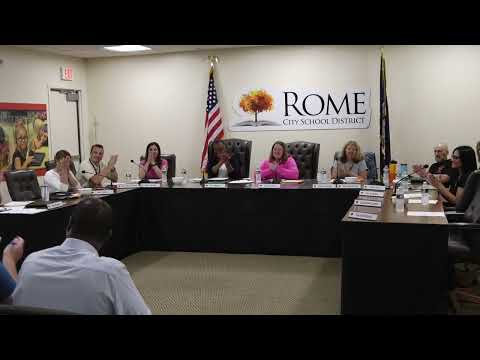
Oneida County Executive Anthony Vicente told the Rome City School District board on June 17 that a proposed Chobani food‑processing campus on county-owned land would be a multibillion-dollar investment that requires large up-front infrastructure work and a phased pilot allocation.
“It's a $1,200,000,000 investment,” Vicente said, describing an initial facility on approximately 300 acres and an estimate of 1,000 to 1,300 employees and dozens of production lines.
The pilot allocation Vicente presented would start at $2,000,000 a year and, in years one through five, be split roughly 45% to the county, 35% to the city and 20% to the school district, with the percentages changing in later phases. Vicente said state grants (he cited a FAST NY grant of about $23 million and another anticipated ~$40 million) and county capital outlays (about $7 million already spent with another $7 million to match) would pay much of the site preparation — new roadwork, a roundabout, sewer and utility hookups and a sound wall — before the plant opens.
Board members pressed Vicente and county staff on two main points: whether the district’s smaller near-term share accurately reflects the costs the district will absorb from added student enrollment and whether those percentages are negotiable. One board member asked how the split was calculated; another asked whether a TIF or bonding model would produce a different near-term distribution. Vicente and other presenters said the county’s approach reflected the unusual fact that the county owns and is investing in the land and infrastructure, and that a TIF/bonding alternative could change the short‑term numbers (county staff estimated a TIF-style financed model could lower the combined near-term pilot to roughly $1.2 million for the taxing jurisdictions).
Superintendent and board members also asked about timing and capacity planning for schools if new employees bring additional families. Vicente acknowledged not everyone who works at the plant would live in Rome and said the county is studying housing and childcare needs alongside job growth; he also committed to working with the district on future phases and percentage calculations.
No action was taken by the school board on the pilot at the June 17 meeting; board members discussed scheduling (the next regular meeting and potential special meetings were mentioned) and asked the county to return for further discussion and, if appropriate, a resolution that could be voted on at a later meeting.
What to watch next: the board will request follow-up details on enrollment projections, a formal resolution if one is proposed, and a clarified fiscal analysis showing the district’s projected revenue and expense impacts before any vote.