Get Full Government Meeting Transcripts, Videos, & Alerts Forever!
Get email alerts on the Professional Development topic
No spam. Unsubscribe anytime.
Board hears plan for executive coaching and grant-funded supports for building leaders
Summary
Dr. Carney outlined a professional coaching plan supported by the ILO group and a resource-allocation grant; the district will use executive coaches, peer specialists and Renaissance tools to support principals, teacher leaders and retention efforts.
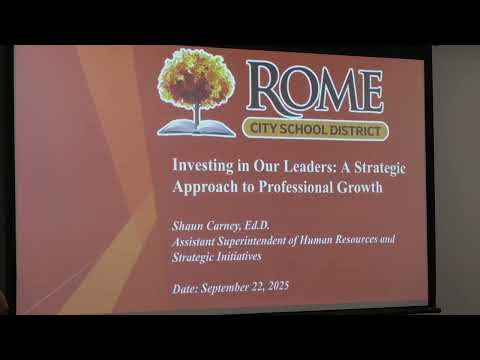
The board workshop featured a presentation by Dr. Carney on implementing an executive coaching and professional learning plan across the Rome City School District, tied to the district strategic plan and funded in part by a resource allocation grant.
Dr. Carney described the coaching model and the district's partnership with the ILO (In the Life Of) group, which has supported leadership retreats and group and one-on-one coaching for identified administrators. "We have over 5,200 students. We have over 1000 employees," Dr. Carney said while outlining why investments in people are central to district success.
The resource allocation grant enabled the district to hire executive coaches who will work with a cohort of administrators and to align teacher leaders, directors and instructional coaches around non‑evaluative, research-based instructional practices. Dr. Carney said the grant also funds targeted work in human resources to improve recruitment and retention and will support development of universal hiring practices at the building level.
Dr. Carney described 25 peer specialists stationed throughout the district to provide instructional and behavioral supports, as well as a Renaissance data platform intended to inform instruction if staff receive adequate training. He emphasized that tools like Renaissance require sustained professional development to be effective.
Board members asked whether one-on-one executive coaching can be expanded beyond the five identified administrators; Dr. Carney said grant funding and additional grants could broaden access, and that group sessions sometimes identify individuals who then receive further one-on-one support.
Next steps include continuing internal investments, seeking additional grant funding and coordinating with BOCES to sustain supports in a cost‑effective manner.