Get Full Government Meeting Transcripts, Videos, & Alerts Forever!
Get email alerts on the District Priorities topic
No spam. Unsubscribe anytime.
Rome City Schools present data‑driven priorities after STAR gains and low regents scores
Summary
District instructional leaders reported year‑over‑year STAR assessment gains across early grades and outlined data‑driven steps — including MTSS, in‑district coaching and targeted regents remediation — while acknowledging low regents pass rates and plans for more review sessions and transportation to increase participation.
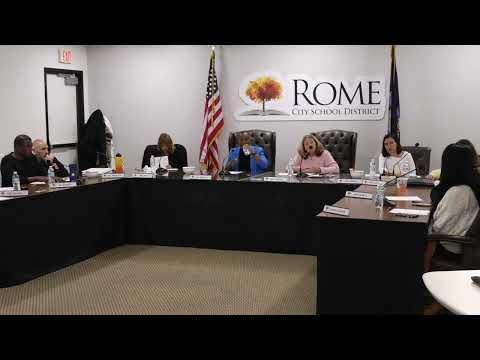
Assistant Superintendent Jennifer DiPerno and the Office of Instruction told the Rome City School District Board on Nov. 11 that last year’s district priorities provided a “North Star” and expanded into a longer annual action plan to capture tangible progress and next steps.
Dana, an instructional lead on the presentation, said the district saw broad growth on Renaissance STAR assessments for pre‑K through grade 8 and that the district is standardizing assessment and professional development. “You’ll see, in our phonics and our reading, we moved up to 72%, 66%, 64% in math,” Dana said, adding that students with disabilities also showed growth on STAR measures.
The presenters connected STAR growth to the district’s strategy for improving New York State assessment performance. DiPerno said STAR improvement has helped prepare students for state tests and that the district saw marked increases from baseline STAR results to projected state proficiency: “For grades 2 through 8, reading went from 32% to 58% and math from 38% to 59%,” she said.
But the presenters acknowledged a concerning regents outcome at the high school. Melissa, who led the regents discussion, reported that passing rates were low across several exams: “Our passing rate was 48 percent for Earth and Space and 32 percent for biology. In algebra we were at 26 percent,” she said, adding that geometry was higher at about 56 percent. Melissa said those rates align with statewide declines and prompted targeted follow‑up.
To address the regents shortfall, the district described immediate and ongoing remediation: summer and pre‑regents boot camps, lab make‑up sessions so eligible students can sit for exams, and expanded review opportunities in January and after school. Melissa said more than 400 students attended August review sessions and nearly half of them passed a subsequent make‑up. She also said the district plans more targeted family communications and logistical supports — such as community pickup hubs — to improve access to review sessions.
The Board heard about systems to sustain and scale interventions. Dana described EduCLIMBER, the district’s MTSS platform, which aggregates attendance, assessment and incident data so grade‑level teams can run data walls and target Tier 2/3 supports. “It takes every single data point we have on every single child in the district and houses it all in one system,” Dana said, noting administrators and RTI providers are being trained and social‑emotional data will be added.
Presenters also described classroom supports and teacher leadership efforts: a district Renaissance consultant embedded four days a week for coaching, common formative assessments, and a peer‑collaborator program with 24–25 teachers opening classrooms to colleagues for observation and feedback. The district plans enhanced in‑person professional development for its new elementary Imagine Learning math rollout and an in‑house coaching cadence.
Why it matters: district leaders framed the work as a multi‑year effort — using data systems and targeted interventions to translate short‑term assessment gains into sustained proficiency. Board members praised staff for the implementation effort and asked for continuing updates as action plans move into measurable outcomes.
The workshop concluded with questions about participation drivers, transportation barriers and next steps; the district said it will publish the final action plan on its website and include the full data appendix in the board briefing.