Get Full Government Meeting Transcripts, Videos, & Alerts Forever!
Get email alerts on the District Budget topic
No spam. Unsubscribe anytime.
Rome City Schools budget preview: staff urges using full tax cap to avoid compounding losses
Summary
District presenters gave a base-budget overview and recommended seeking the full allowable tax cap to avoid recurring lost revenue; staff outlined expenses including salaries (~$69M), insurance (~$43M) and capital-reserve planning for a Phase 2 building project.
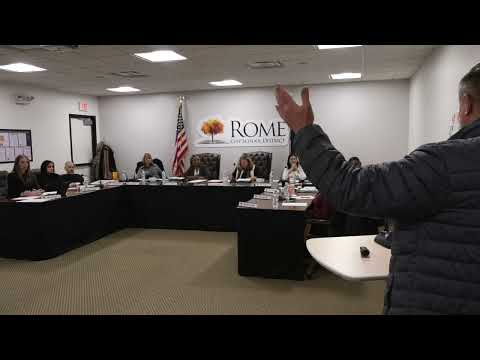
A district presenter opened the Rome City School District’s budget season with an overview of the base budget and a short exercise showing how forgoing the full allowable tax levy compounds into permanently lost revenue over multiple years.
"If in 2021–22 we decided that the tax cap could have been 2.31% and we instead went out at 1.99% — only a third of a percentage point — we would have left $130,000 on the table for that year," the presenter said, warning that small, repeated under-levying compounds over five years into greater lost revenue. The presenter recommended that the district go out at the tax cap to avoid future fiscal stress while building reserves for capital projects.
Staff outlined the major budget assumptions and snapshots for the 2026–27 planning horizon: salary costs roughly $69,000,000 (with grant support projected at roughly $6,000,000 toward salaries), utilities and facilities near $5,000,000, insurance and benefits estimated around $43,000,000 (based on a 7% increase from the consortium), bonding for capital projects projected at about $8,300,000, and projected total base expenses in the mid-$150 million range. The presenter said the district plans to direct excess revenue to capital reserves, including planning for a fifth-grade side of a Phase 2 building.
Board members asked clarifying questions about whether staff planned to seek the maximum tax cap; the presenter said that was the recommendation but the board would decide. The presenter also discussed transportation planning: the district recently purchased a bus, is receiving another in January, plans to add two diesel buses next year, and is working with a transportation consultant to seek a waiver for three years while infrastructure for electrifying the fleet is evaluated. Staff said they are working with NYSERDA and First Student on electrification options over a 3–5-year horizon.
What happens next: the presenter said the finance committee will meet in mid-January for a detailed review and staff will provide a more detailed tax-cap calculation in a forthcoming presentation.