Get Full Government Meeting Transcripts, Videos, & Alerts Forever!
Get email alerts on the Physical Security topic
No spam. Unsubscribe anytime.
Mahopac outlines expanded physical-security upgrades, districtwide CRG maps and 3D building scans
Summary
District leaders detailed physical-security improvements — Armored1 window film (phase 1 complete, phase 2 planned), district-wide CRG maps for first responders, lockdown shades, privacy film and planned 3D building scans — and said the measures aim to speed response and reduce risk.
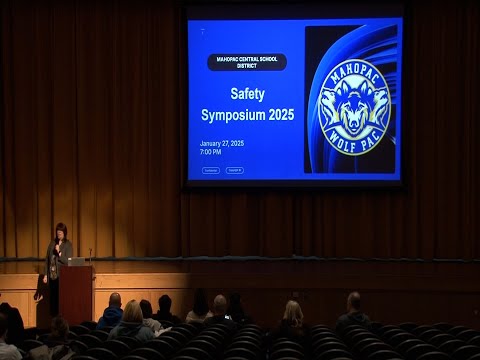
Superintendent Christine Tona opened the Mahopac Central School District's first districtwide safety symposium and turned the program over to Troy Bilyeu, the district administrator for safety, who outlined a series of physical-security upgrades planned for the coming year.
Bilyeu said the district completed phase 1 of an Armored1 window-film program that covers main entrances districtwide and is seeking county funds to extend the film to remaining doorways and cafeteria windows in a phase 2 rollout. "Phase 1 was on the main entrances ... it's not bulletproof but it will actually impede anyone trying to break through the window to get into the building," Bilyeu said.
Benjamin August, the district's director of technology, described locks and staff ID programming that can be enabled or disabled in real time during security events and interior/exterior alarm signaling that communicates lockdown states to staff and the public. "These IDs can be programmed to allow access, enabled or disabled based on security conditions," August said.
Austin Sprague, chief operating officer of Critical Response Group, described collaborative response graphics (CRG) that standardize school floor plans into accurate, labeled maps usable across multiple 911 and dispatch systems. Sprague said CRG teams physically verify floor plans on site, correct orientation and structural inaccuracies, and add site-specific labels such as ‘‘auditorium’’ or ‘‘Room 12’’ so first responders and dispatchers share a single location language.
"We send an on-site team who physically walks the structure ... they fix the base layer structurally and gather all the site-specific labels," Sprague said. He also said CRG maps are integrated into dispatch and incident-management tools free of charge and offered free tabletop exercises to test plans with schools and public-safety partners.
Troy Bilyeu said every district building has been mapped with CRG products and that law enforcement will navigate buildings using the maps during the remaining lockdown drills this semester to improve on-scene navigation. He noted one recent drill where the exercise added about one minute to response time but provided useful operational learning.
The district also intends to install lockdown shades in classrooms, apply privacy film on cafeteria windows so those inside can see out but outsiders cannot see in, increase overnight and after-school security presence, and train all administrators on AED use for events where athletic trainers are not present. Bilyeu said the district will also conduct 3D image mapping of every building in partnership with the Department of Homeland Security during the February break to provide an additional planning resource for responders.
The symposium closed with a QR-code link to a Google form for follow-up questions and an invitation for attendees to speak with presenters after the event.
The district said the measures are designed to create time and clarity for responding officers and to improve unified communications during incidents. Next steps include funding and scheduling for Armored1 phase 2, finalizing contracts or MOAs for any off-site staging, and integrating CRG/3D outputs into local dispatch systems.