Get Full Government Meeting Transcripts, Videos, & Alerts Forever!
Get email alerts on the District Budget topic
No spam. Unsubscribe anytime.
Hamburg Central School District board adopts 2025–26 budget as transportation provider rejects CPI renewal
Summary
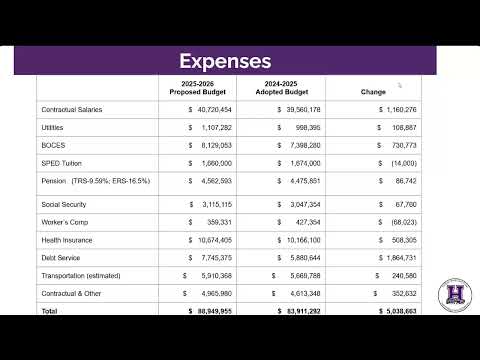
The Hamburg Central School District Board adopted a balanced $88,949,955 proposed 2025–26 budget to present to voters and discussed an unexpected transportation-provider decision: Fisher Bus declined a CPI renewal, prompting the district to plan an RFP that could raise transportation costs next year.
The Hamburg Central School District Board of Education adopted a proposed $88,949,955 2025–26 budget Monday and heard that a major transportation contractor rejected a CPI-based renewal, forcing the district to seek competitive bids.
"So, as you probably are aware, there is no state budget yet," said Christine, the district presenter, opening the budget discussion and noting the board must adopt a budget before state figures are finalized. She told the board total revenues and expenses for 2025–26 were shown in the slides and that the overall dollar increase from the current year is $5,038,006.63.
Board members probed how recent news from Fisher Bus could affect that outlook. A district staff member briefed the board that Fisher refused to accept renewal tied to the consumer price index, saying the company was "not" renewing at CPI and that the district now must issue a request for proposals. "This was based on the idea that they would renew at CPI. They are not," the staff member said, explaining the decision means the transportation line could rise above the figure included in the budget the board was asked to adopt that night.
Christine added that two separate summer contracts (special-education and sports runs) agreed to renew at CPI and therefore will not go out to bid; the change affects service starting Sept. 1. She also said the district had budgeted a 3.1% CPI estimate while acknowledging final CPI figures arrive after voters approve a budget.
On operational details, Christine said the district runs roughly 37 home‑to‑school buses and more than 50 total routes when including out‑of‑district and other runs, underscoring the scale of transportation service that would be affected if costs rise. Board members discussed whether to write the RFP to favor newer fleets or other criteria, with Christine saying the district would use its 2017 RFP as a template and consider weighted criteria that emphasize bus age and safety.
Board members also raised whether the district's recently purchased routing software would remain usable if a new vendor succeeds Fisher. Christine and others said the district owns the web‑based software and student data and that while compatibility cannot be guaranteed, many providers use similar systems.
Despite the procurement uncertainty, the board voted to present the adopted budget to voters as Proposition 1 on May 20. Christine reminded the public of the budget hearing on May 13 and the mail date for the budget newsletter (May 14).
What happens next: the district will draft and issue an RFP for transportation services, evaluate vendor proposals against the district's stated criteria, and monitor actual CPI figures; auditors and the district's finance staff will also assess fund-balance options if transportation costs rise.