Get Full Government Meeting Transcripts, Videos, & Alerts Forever!
Get email alerts on the Academic Performance topic
No spam. Unsubscribe anytime.
Brown Deer board cites districtwide gains on state assessments as report cards released
Summary
Administrators presented state assessment and school report-card results showing notable gains in mathematics and overall district performance; the district’s score rose to 71.2 and several grades showed double-digit increases, prompting praise and plans for targeted instructional work.
Administrators presented a summary of the district’s 2024–25 state assessment results and the new school report cards, highlighting substantial year-over-year gains in student performance and increased participation in advanced coursework.
The administration told the board that Brown Deer’s district score rose to 71.2 on the state report card, moving the district into the "exceeds expectations" band for the first time in years. "From 2021 to ’22 we were at 61.9 meeting on the state report card. Today, we’re at 71.2," said Dr. Glass, who narrated the slide deck and emphasized the district’s comparative growth relative to peer districts. Administrators said the district’s overall growth rate is about 4.7 percent.
Presentation materials showed third-grade ELA proficiency increased to 58.1 percent in 2025, about eight percentage points higher than the state average for that grade, and that third-grade mathematics rose from 61.6 percent to 76.1 percent — a 14.5-point gain. Administrators also reported large increases in middle-school math (with eighth grade up roughly 18 points) and that Brown Deer Elementary outperformed the state in mathematics.
Board members pressed administrators on performance dips in transition grades, such as fifth-to-sixth and ninth-to-tenth grades. Administrators attributed the gaps to foundational skill deficits, particularly with fractions and depth-of-knowledge expectations, and described district actions including vertical-alignment work, a vertical math team at the elementary level, targeted professional learning for teachers and a February PD focus on student feedback and clarifying misunderstandings.
"We’ve been mapping standards backwards and focusing on depth of knowledge so students know what analysis and judgement look like," Dr. Khan said, outlining curriculum and instructional strategies aimed at improving higher-order thinking skills across grades.
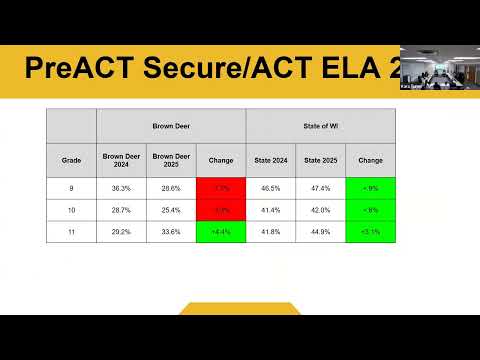
The high school reported growth in AP participation — from 31 students taking AP exams in 2021 to 99 most recently — and an increase in the number of students scoring a 3 or higher. The district also noted modest improvement in ACT performance and that changes to the ACT format this year (shorter passages and some two-day testing options) could reduce testing fatigue.
Board members and district leaders praised staff and students for the progress and agreed to continue monitoring and responding to data. Dr. Khan thanked staff for the work that produced the gains and said the district will continue using data-driven strategies to sustain improvement.
The board received the report; no formal action was required on the presentation itself. The school report cards were released publicly the same day as the meeting.