Get Full Government Meeting Transcripts, Videos, & Alerts Forever!
Get email alerts on the Procurement And Operations topic
No spam. Unsubscribe anytime.
Mercer County Schools board reviews consent agenda; approves routine minutes and adopts social-media cost‑recovery participation
Summary
At the Feb. 23 meeting the Mercer County Board of Education approved routine business including minutes and a consent agenda of purchases and contracts. Notable items presented included a technology device refresh (~803 student laptops, $297,000) and a network upgrade ($884,450.21) with E‑Rate support; the board also approved joining a social‑media/gaming cost‑recovery program.
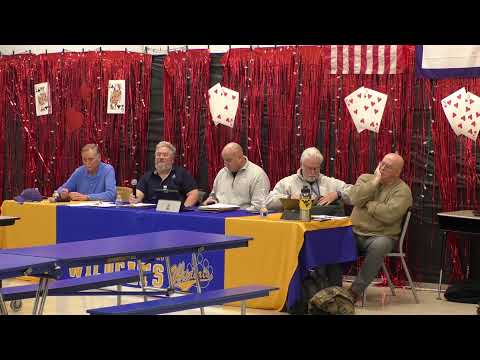
The Mercer County Board of Education on Feb. 23 approved routine business and reviewed a long consent agenda that included procurement, contracts and program authorizations.
The board approved minutes from its Feb. 9 meeting and then heard the superintendent read the consent agenda. Items presented included a Fuelmaster fuel-system upgrade (board memo lists a unit cost of $14,020.35 with installation of $1,857, producing a memo subtotal of $15,008.85; the superintendent later referenced $15,885.35), food‑service and small‑works purchases, athletic uniform purchases, gym-floor refinishing contracts, and vendor awards for catering for multiple banquets.
Technology and services on the consent agenda included a student-device refresh (803 Lenovo student laptops, total cited as approximately $297,000 using excess levy funds) and a network infrastructure upgrade across schools costing $884,450.21, with $751,782.72 committed from E‑Rate funding (leaving a local remainder of $132,667.52). The board also reviewed a new Education Master Services Agreement with Emeritus Healthcare Staffing to provide supplemental special‑education staff and services.
Board members asked questions about recurring costs and access controls for the Fuelmaster upgrade; staff explained the purchase is a one‑time acquisition (no ongoing license fee for the base unit) and that the new system will support badge and fob access and more granular reporting to improve accountability. On special‑education instructional supports, staff noted some services will be in‑person rather than virtual for the coming year.
On a separate agenda item, staff said the district submitted a waiver to the West Virginia Department of Education to recover four missed instructional days; as a result the calendar was adjusted so the last student day is now June 11 (previously June 9), assuming no further snow days.
The board also voted to participate in a no‑cost (to districts) social‑media/gaming cost‑recovery program presented at a state conference. A board member moved the recommendation, a second was recorded, and the motion carried. Staff characterized the program as contingency‑based: districts pay nothing unless an award is recovered.
Quote: "It's no cost to the counties — you can only gain," one board member said during the discussion of the gaming/social-media cost‑recovery program.
Next steps: approved consent items will move to implementation under the appropriate administrative departments; staff will return with additional policy drafts (resident student transfer policy was set for public comment) and with cost‑estimate work requested by the board for HOPE scholarship athletic fees to ensure any charges are "reasonable" and tied to actual costs.