Get Full Government Meeting Transcripts, Videos, & Alerts Forever!
Get email alerts on the Strategic Plan topic
No spam. Unsubscribe anytime.
Superintendent reviews Wooster City Schools strategic-plan progress, flags facilities and safety needs
Summary
The Superintendent gave a final update on the district's three-year strategic plan, citing gains in academics, mental-health supports, a full one-to-one Chromebook rollout and the need for renewed facilities planning, including a recent $7 million HVAC project at Edgewood funded with federal COVID relief.
The Superintendent presented the Board of Education with a final update on Wooster City Schools’ three-year strategic plan, listing accomplishments across academics, student supports, technology and facilities and saying the district will begin a new planning cycle this spring.
He told the board the plan, launched in 2021 and implemented in 2022, was intended as a three-year guide for district decisions and that the district will invite community feedback on a new strategic plan with the hope of adoption in late spring or early summer. “We had our best report card, in my time here at Wooster,” the Superintendent said, adding that assessments are one useful measure, not the only measure of success.
On academics, he described a robust, annual curriculum-adoption process and efforts to align course offerings so AP, CCP and credit-flexibility options do not duplicate one another. He said the district discontinued its International Baccalaureate program because junior-class enrollment had fallen to about five students and that career-technical education has expanded with grant-supported programs in welding and fabrication and health technologies.
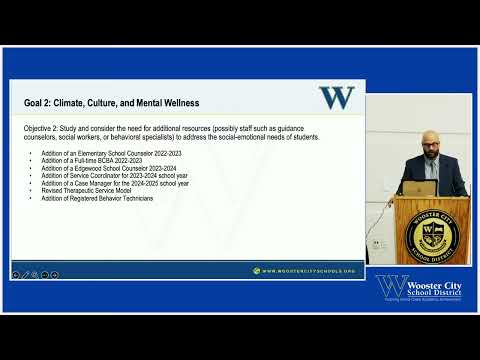
The presentation highlighted supports for climate and student wellness. The board recently created a service-coordinator role (Mrs. Olsen) originally funded by a grant and retained to coordinate wraparound services. The Superintendent said the district shifted its therapeutic counseling model toward ongoing, primary-care-style supports and added staff including elementary and middle-school counselors, a behavior specialist, and registered behavior technicians (RBTs) to provide ABA-style interventions and de-escalation support.
He said the district previously paid more than $500,000 a year to an outside therapeutic-provider contract (transcript name: “Anasol”) and has maintained comparable service levels while reducing that expense to roughly one-fifth of the prior annual cost by billing insurance and Medicaid where treatment documentation allows.
Technology and privacy compliance were prominent. The district completed a one-to-one Chromebook rollout (more than 2,000 devices) and produced a Chromebook handbook for staff and families. The Superintendent said the technology team responded to state student-privacy requirements under Senate Bill 29 to ensure compliance. “Being 1 to 1 is not the answer. Being 1 to 1 is a resource,” he said.
On safety, the Superintendent credited Mr. Madigan for leading security work and listed recent investments: safety grants, emergency-response training including active-threat drills for buses (the START program), new radios, bus-tracking GPS software available to families, and an alert system referred to in the transcript as the “Syntegic” alert system, which the Superintendent said includes facial-recognition cameras and links for immediate police response.
Facilities and finance were raised as urgent planning items. The Superintendent said the district has not passed a levy, has produced multiple facilities master plans, and must re-evaluate long-term facility strategies. He listed recent capital work — natatorium and pool HVAC improvements, athletic-field renovations and roofing projects — and cited a roughly $7,000,000 HVAC project at Edgewood paid with federal COVID-relief dollars. He noted the district could pursue OFCC co-funding for any major building project.
The Superintendent also described communication and engagement steps: a communications coordinator (Mrs. Howell), a redesigned website credited to Alex Gary, regular placements in local outlets and a new deeper-dive video series spun off from the district’s 'Tutor Talk' program to explain topics like facilities and budgeting. Mrs. Welty will present a monthly financial forecast to help the community understand revenue and expenses and future projections.
He closed by thanking staff and community partners — including the Akron-Canton Food Bank, Goodwill and regional youth-services partners — and said district leaders will begin a new strategic-plan feedback process in spring.
Next steps: the board will receive the finance forecast that evening and the district will announce details for community input into the next strategic plan.