
North Ridgeville board hears forecast showing up to $15M hit from recent property-tax reforms; approves consent and project acknowledgements
Get AI-powered insights, summaries, and transcripts
Subscribe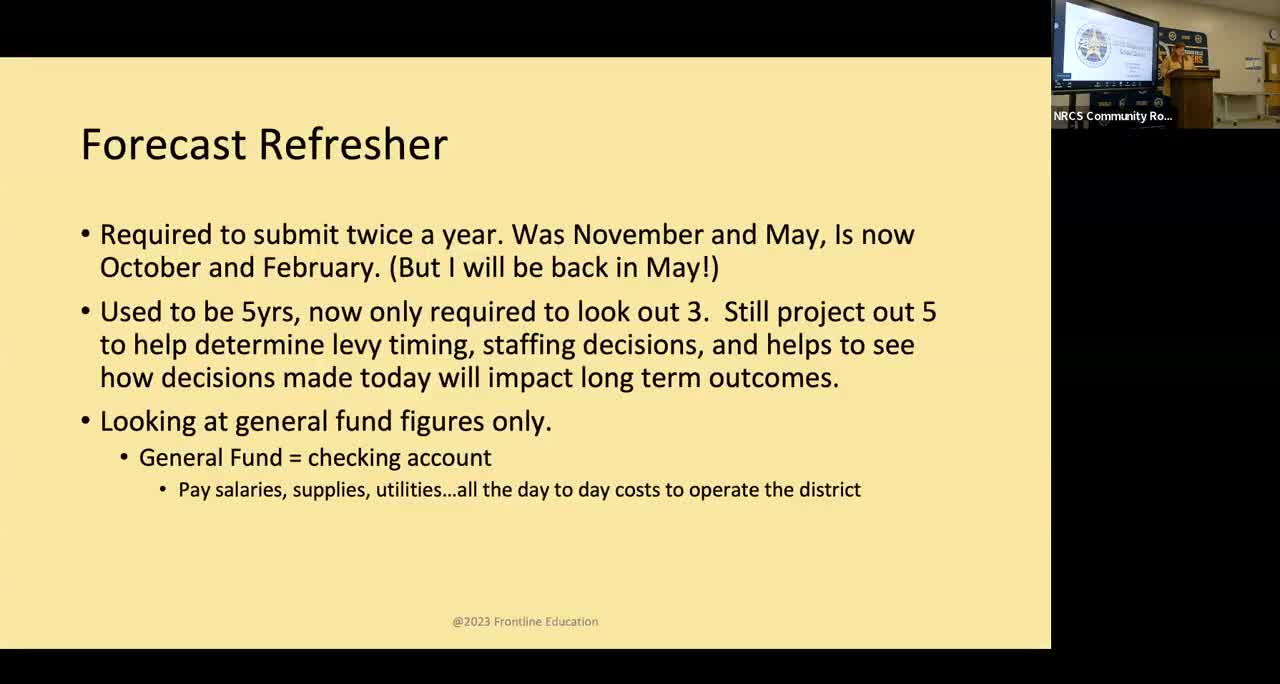
Summary
Treasurer warned the district could collect nearly $15 million less from 2026–2030 because of several recent Ohio property-tax bills, shrinking projected reserves and days of cash on hand; the board approved the consent agenda, finance items and acknowledged OFCC design-phase comments for the new high school.
On Feb. 17, 2026, the North Ridgeville City Board of Education heard a five-year financial forecast and approved routine consent and personnel items while acknowledging Ohio Facilities Construction Commission (OFCC) design-phase comments for the district's new high school project.
The treasurer, identified in the meeting as Mrs. Fanta, told the board that the district currently projects about $61 million in revenue and roughly $59 million in spending for the current fiscal year, meaning an expected year-end general-fund balance near $23 million. She said about 63% of revenue comes from local property taxes, state funding accounts for roughly $17.9 million (including about $12 million from the state school funding plan), restricted grants total about $947,000, and other revenue about $4.8 million. On the spending side, personnel costs account for about 82% — roughly $48 million — with purchased services at about $7 million and other categories around $3.4 million.
Fanta walked the board through four pieces of recently passed or discussed state legislation that affect school property-tax calculations (the transcript references House Bill 920, HB129, HB186, HB335 and combined items referred to as HB309/96). She said the cumulative effect of those changes would reduce district receipts by “almost $15,000,000” from 2026 through 2030 compared with the district’s October forecast. She also presented model runs showing the district’s projected days of cash on hand falling from about 166 days (October projection) to roughly 46 days by 2030 — below the district policy minimum of 90 days. Fanta said the changes would turn forecast surpluses in later years into multi‑million‑dollar shortfalls in some scenarios.
Board members and attendees reacted strongly. At one point a board member said the changes left him “in a color worse than red,” arguing the county and state actions had effectively diminished locally approved levies. The treasurer also told the board the district had already received a first tax advance of about $2,000,000.
The board moved to approve the consent agenda and then approved two finance items in one reading: the monthly financial statements and the financial forecast and assumptions report. The meeting record shows the motions were moved and seconded and passed on roll-call votes recorded in the public meeting.
In buildings-and-operations business, the board approved a resolution acknowledging OFCC design-phase review comments for the new high school and agreed to complete required revisions outlined by the commission. The motion to acknowledge OFCC comments passed on roll call.
Under human resources, the board approved a bundled report including a support-staff appointment, a substitute contract, five certified leaves, two support-staff leaves, a supervisor resignation, a certified-staff resignation and a support-staff resignation. The board then moved and approved entering executive session to discuss personnel and negotiations; the board noted no action would follow the executive session.
The treasurer and principals who presented to the board also highlighted non-financial work — including curriculum adoptions, multi-tiered systems of support (MTSS) interventions, an SEL program called Zones of Regulation and an attendance partnership with the Cleveland Browns’ “Stay in the Game” initiative — as evidence of ongoing instructional and student-support efforts.
What happens next: the board approved the forecast report and related finance actions on Feb. 17; the treasurer said she will re-present the five‑year forecast in May when more data (tax collections and county budget-commission decisions) are available. Board members and district leaders indicated they will continue planning for possible spending reductions and staffing changes if the state and county changes materially reduce revenue.