
Committee Hears Bill to Include Tribal Representation in Transportation Planning
Get AI-powered insights, summaries, and transcripts
Subscribe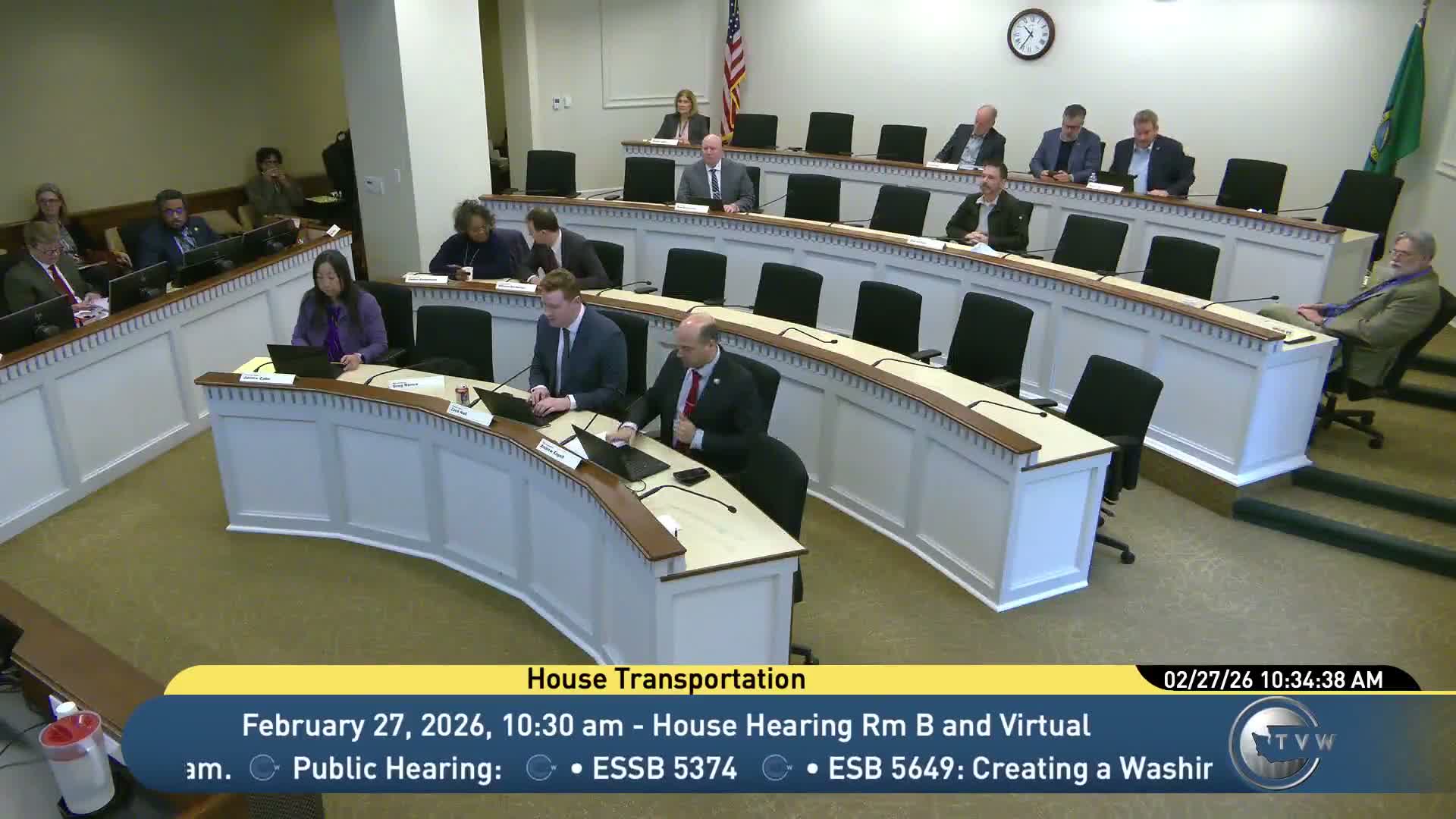
Summary
A legislative committee heard House‑engrossed Substitute Senate Bill 5,374, which would require counties to include affected tribal governments in intergovernmental coordination for transportation elements of comprehensive plans and establish a tribal traffic safety coordinator grant program; staff described indeterminate fiscal impacts and implementation details.
The committee heard House‑engrossed Substitute Senate Bill 5,374 on including tribal representation in certain transportation activities. Elizabeth Wren, staff to the Local Government Committee, briefed the measure and described how it would require intergovernmental coordination to “include affected tribal governments and an assessment of the impacts on affected tribal areas,” and would establish, subject to funding, a tribal traffic safety coordinator program.
The bill would align the six‑year comprehensive transportation program process with the Growth Management Act’s coordination requirements, Wren said, adding that a federally recognized Indian tribe may voluntarily choose to participate in county or regional planning and that jurisdictions must negotiate in good faith to develop memoranda of agreement for collaboration.
Jennifer Harris, committee staff, summarized the fiscal note as indeterminate and said program costs would depend on appropriations. Harris cited illustrative estimates in the staff record: a base grant‑manager cost near $15,000 annually for a partial FTE, a stated minimum cost of roughly $136,000 per tribe annually for a tribal traffic safety position, and a Senate transportation budget proposal that included amounts for tribal traffic safety coordinators and grants. Harris emphasized the overall fiscal impact for local governments is unknown and will depend on how many sovereign nations participate and on appropriations.
Axel Swanson, testifying for the Association of Counties, said the association supports the bill and asked for statutory crosswalking with the existing GMA coordination process to avoid confusion. “We’re testifying today in support of this bill,” Swanson said, and told members the measure should not force counties to “start all over” with near‑complete plans; rather, he said, it is intended to ensure timely notice and a negotiated memorandum‑of‑agreement process.
Members asked whether the bill would require jurisdictions that are already far along in planning to reopen work; staff and the county representative said the bill does not specify a retroactive cutoff and should be implemented prospectively through coordination and MOUs, not by requiring jurisdictions to restart completed planning processes. Committee members also asked about funding sources and whether the program would place new burdens on counties; witnesses said some counties already do similar outreach and that costs will vary by county and by the number of tribes participating.
The chair closed the public hearing after noting that Swanson was the only person who had signed up to testify on the bill. The committee took no action and moved on to a separate measure.