Get Full Government Meeting Transcripts, Videos, & Alerts Forever!
Get email alerts on the Construction Renovation topic
No spam. Unsubscribe anytime.
Board reviews $293,000 in high-school change orders, hears objections to advancing phase 2 work
Summary
District construction advisers outlined roughly $293,000 in recommended change orders — including a $254,072 soil undercut for pyritic material — and said doing phase‑2-related remediation now would save cost and schedule; some board members and citizens urged clearer public notice that phase 2 work is advancing before formal approval.
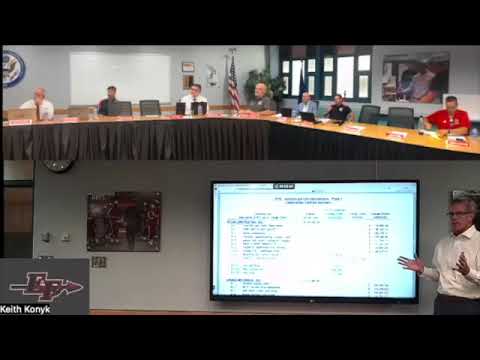
District construction advisers presented several recommended change orders and a status update on the high-school renovation during the Elizabeth Forward School District committee meeting on Wednesday, July 9. The board heard detailed line items, questions from members and public comment urging clearer communication about phase 2 work.
The advisers flagged two recent facade change orders — GC7 for $19,897.05 and GC8 for $28,005.77 — saying demolition revealed framing that was not installed as the drawings indicated and that additional demolition and new framing were needed. "GC7 is for facades B and E and GC8 is for facade F," the district's construction adviser said, noting the extra work arose after demolition uncovered discrepancies in the original structure.
A larger item under review was change order GC10: undercutting, sealing and backfilling an area where geotechnical testing found pyritic (expansive) soils in the phase‑2 footprint. The construction adviser recommended the district take that work into the current contract, saying it avoids higher costs and schedule impacts later. "This is to under the phase 1 contract... the excavation, the sealing of that pyrite," the adviser said, and recommended approval of the $254,072.05 figure.
Smaller trade items included a plumbing change order (PC3) of $2,534.29 to install an area drain and improve the loading-dock slope, electrical wiring work for unit ventilators for $33,960, and a $2,460 cost for a pad-mounted transformer and conduit, with some credits for deleted doors and associated devices offsetting parts of the total. Taken together, the change orders on the agenda totaled $293,026.34, and staff said that, after these items, the project had used about 21.51% of its contingency budget and change orders represented roughly 1.08% of the contract value.
Contractors and staff defended doing some phase‑2‑area work now. They said removing unsuitable soils and sealing them before backfill yields better on‑site backfill material, saves mobilization/demobilization costs, and shortens the later phase‑2 construction window. "We have a considerably better number here than you would if we said let's wait and do it at phase 2, both cost and the cost associated with the schedule," the construction adviser told the board.
Public commenters and several board members pressed that the district must be clear about what is officially approved. Margaret Warren asked why work tied to the not‑yet‑approved phase 2 was being added as a change order: "Phase 2 isn't approved — so should it have been just a separate work order or out for bid?" she asked. Staff said the design and foundation drawings for phase 2 were sufficiently advanced to identify unsuitable soils and that doing the remediation now reduces cost and schedule risk.
A public commenter, Leslie Messina, asked for the current percent complete and raised concerns about whether students would return on time. Staff said phase 1 is roughly 50% complete and that classroom areas are prioritized for in‑seat occupancy at the start of the school year; heating is scheduled to be in place by Nov. 1 and air conditioning by next spring. "Phase 1 is now 50% complete," staff stated.
The board did not vote on the construction change orders during the committee meeting; staff said they would present the recommended items for board review and formal approval where required. The discussion underscored a recurring tension in the renovation: balancing cost and schedule savings from performing certain phase‑2‑adjacent tasks now against the need for transparent public procurement and explicit board approval for later phases.
Looking ahead, staff said the district remains roughly halfway through the contract and that remaining contingency (shown in staff materials) stood at approximately $2.36 million under a 5% contingency model. Board members requested clearer public updates on phase 2 timing and public access to the design documents once bids and plans are posted.