Get Full Government Meeting Transcripts, Videos, & Alerts Forever!
Get email alerts on the Tax Roll 2024 topic
No spam. Unsubscribe anytime.
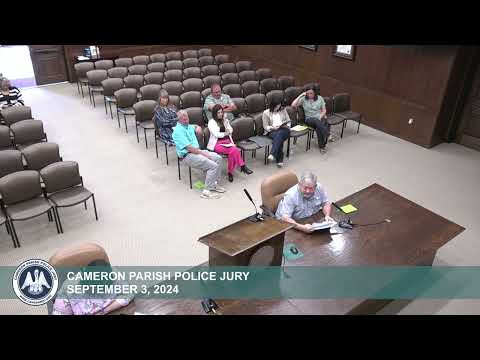
Cameron Parish Police Jury adopts 2024 tax roll; members ask staff to study homestead exemption and Creole water district taxes
Summary
The Cameron Parish Police Jury voted to accept the 2024 tax roll after a presentation from Scott on assessed values and revenue drivers. Members asked staff to investigate whether the $75,000 homestead exemption can be adjusted and sought clarification on Creole (Water District 7) tax labeling and pipeline-related collections.
The Cameron Parish Police Jury voted to accept the 2024 tax roll on Oct. 7 after a staff presentation that showed a slight rise in assessed values and explained how taxable value (after homestead and military exemptions) translates into potential tax dollars for parish entities.
Scott, who presented the grand recap, walked jurors through the recap sheets and said the right-hand column lists the potential tax dollars each entity could collect “if everybody would pay their taxes.” He noted assessed values rose slightly this year and that parish-wide totals are larger than individual district numbers.
During discussion, a juror asked Scott to research whether the current homestead exemption level — referenced in the meeting as $75,000 — can be changed locally or requires state action. “I’d like to find out a little bit more information along homestead exemption and see what the possibilities is,” the juror said. Scott replied he would investigate at district and state quarterly meetings and report back.
Jurors also raised questions about Creole, identified in the materials as Water District 7 and shown on a line labeled “maintenance.” One juror asked whether that entry represented a maintenance-only tax or the district’s overall levy; Scott confirmed the label reflects how the district historically named the item and that it is the district’s tax.
Scott and jurors discussed parish revenue shifts over recent years, saying declines in oil-and-gas production reduced that tax base while liquefied natural gas (LNG) plants helped to stabilize receipts. Scott characterized the LNG contribution as substantial, saying “LNG paid right at half of the taxes last year,” and a figure of $33,000,000 was referenced during that exchange. He also explained that pipelines are placed on the tax roll once they are in service, citing the Venture Global 42-inch line and noting smaller facilities, such as the Trosclair Road site, have generated collections.
The meeting included an explanation of how the parish classifies lots: parcels over 3 acres that are not in a subdivision are typically considered agricultural for assessment purposes, while subdivision lots generally carry higher market values and higher taxes. Scott used local examples, including sales in Hackberry and Grand Lake, to illustrate the market-driven differences in assessed value.
A juror moved to accept the 2024 tax roll; the motion was seconded (the chair identified the movers in the record as Mr. Michael and Mr. Sam), the chair called for a voice vote and recorded the motion as carried after an affirmative response of “Aye.” The transcript does not record a roll-call tally or exact vote counts.
The jury recorded acceptance of the tax roll and concluded the agenda item; Scott said he would follow up on the requested research into homestead exemption options and provide further information at a later meeting.