Get Full Government Meeting Transcripts, Videos, & Alerts Forever!
Get email alerts on the Election Timing topic
No spam. Unsubscribe anytime.
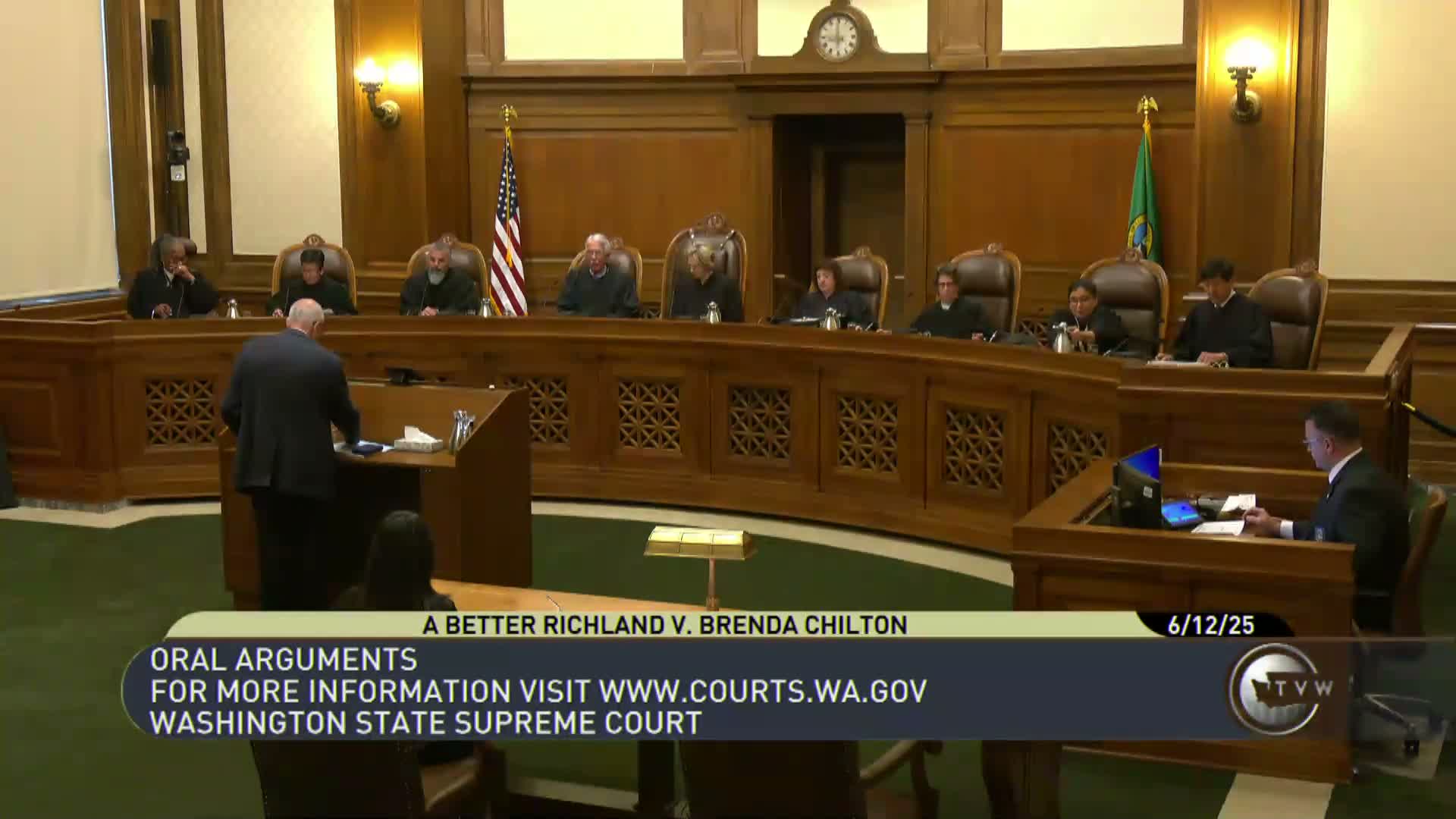
Washington Supreme Court weighs whether Richland charter petition must go on the 'next regular municipal election'
Summary
At oral argument June 12, attorneys debated whether the phrase "next regular municipal election" requires placing a Richland charter amendment petition on the next scheduled city general election or whether primaries or special elections qualify; counsel for the petitioner argued a restrictive auditor interpretation would delay voter choice, while the auditor rgued the statute is clear and the trial-court order should stand.
The Washington Supreme Court heard oral argument on June 12 in Abedder Richland v. Brenda Chilton over when a citizen petition to amend a city charter must be placed before voters.
Douglas McKinley Jr., identified in the transcript by the court as opening counsel for the appellant, told the justices he would focus on the "practical implications" of the auditor's reading of the operative statute and warned that, under that interpretation, a petition submitted in December could be delayed for "23 months later and 6 elections later" until November 2027. "What we're really deciding is do the voters of Richland get a choice," McKinley said, urging the court to read "next" as the soonest available opportunity to vote.
Deputy Prosecuting Attorney Leanne Holt, representing respondent Brenda Chilton in her capacity as Benton County Auditor, told the court she did not believe the statute is ambiguous. "I do not believe the statute is ambiguous," Holt said, arguing the petition must be read in light of the statutory definitions governing general and municipal elections and the city's governing rules. She urged the court to defer to the auditor's reading and to uphold the trial court's writ of mandamus denial, saying the appellant had not carried the clear-duty burden that mandamus requires.
Much of the argument turned on textual parsing: whether "regular" implies a recurring fixed-date general election (the city general election held in odd-numbered Novembers, argued Holt) or whether "regular" can encompass primaries or statutorily provided special-election dates (an interpretation counsel said would allow an earlier vote). A justice pressed the parties to explain whether "election" should be understood as the act of voting or as the particular contest on the ballot; counsel and the court also discussed whether precedent permitting charter amendments at special elections (discussed by counsel as Henley/Hindley in the transcript) controls.
Holt also noted a statutory distinction between special elections called by a governing-body resolution and petitions initiated by the people, arguing that the latter cannot rely on the governing-body resolution mechanism for special-election timing. Counsel for the appellant countered that allowing officials to adopt a more restrictive interpretation whenever the statute is ambiguous would let them "thwart the will of the people," and argued the Court must read the statute to effect timely voter participation.
Both sides acknowledged practical complications: McKinley said putting the measure on an earlier primary could create chaos because candidate filing deadlines may already have passed; Holt noted the early-2025 special-election windows have already passed and that the county auditor plans to place the measure on the November general election, which could render the appeal moot but still leave an important legal question for future cases.
The court asked detailed questions about statutory definitions (several RCW sections were cited in argument) and the historical development of primaries and municipal-election timing. The justices thanked counsel, submitted the case, and recessed.
The Court did not announce a decision at the conclusion of oral argument; the matter was submitted for decision.