Get Full Government Meeting Transcripts, Videos, & Alerts Forever!
Get email alerts on the Criminal Sentencing topic
No spam. Unsubscribe anytime.
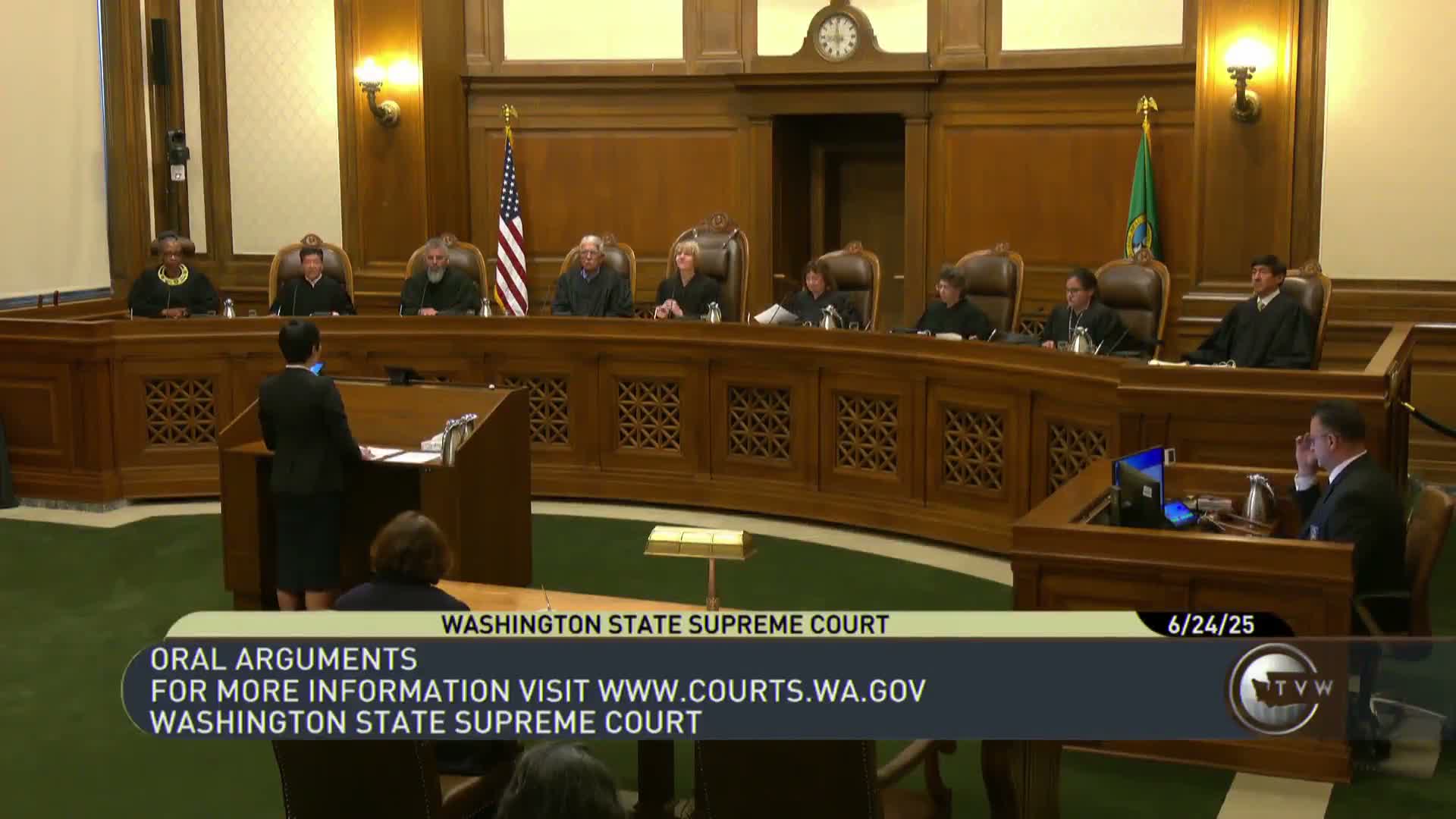
Washington Supreme Court weighs whether resentencing must be full and whether restitution is an excessive fine
Summary
At oral argument in State v. James Ellis, the court heard competing views on whether vacation of a prior conviction required a full de novo resentencing that would allow youth and rehabilitation evidence and whether a $7,000-plus restitution order functions as a punitive fine under the Eighth Amendment.
Olympia — The Washington State Supreme Court heard argument Tuesday in State of Washington v. James Ellis over whether a resentencing tied to a prior conviction vacated under Blake requires a full, de novo sentencing and whether the restitution portion of Ellis’s punishment is an "excessive fine."
Beverly Tsai, an attorney with the Washington Appellate Project representing Ellis, told the justices the resentencing that followed the vacation of a prior drug-possession conviction changed his offender score and "the entire scope of sentencing," and that the trial court erred by refusing to hear mitigating evidence about the defendant’s youth and rehabilitation. "Restitution is punishment," Tsai said, and "the amount in this case is grossly disproportionate and therefore unconstitutional."
The argument centered on two linked questions: whether a Blake-based resentencing can be limited to mechanical recalculation of a range, and whether a restitution order imposed after vacation of a conviction can be reviewed on direct appeal as a manifest constitutional issue. Tsai urged the court to remand for a new sentencing hearing and to reverse the restitution order.
Theresa Chen, a deputy prosecutor for Pierce County, told the court the challenged sentence "is the very sentence he asked for and agreed to," and that the restitution at issue — ordered to cover actual and reasonable funeral expenses — is compensatory, not a fine, and therefore not categorically subject to the Excessive Fines Clause. Chen said the restitution remains waivable through administrative review by the Department of L&I if the defendant later requests a reduction for inability to pay.
The justices questioned both sides about precedent and practical consequences. They explored whether the state’s Harris line of cases limits resentencing relief where a defendant’s plea or sentencing recommendation would be undermined, whether the trial court in this case actually "refused" to consider mitigating evidence or instead sought notice before entertaining an exceptional downward request, and whether the existence of a victims' compensation intermediary affects the punitive character of restitution.
At times the discussion turned to legal standards: Tsai invoked the Long proportionality factors and United States Supreme Court precedents addressing punitive sanctions, while Chen cited Bearden and other cases to emphasize that inability to pay bars contempt-based penalties and that restitution paid to victims is not revenue for the state. The parties disputed whether the resentencing here should be treated as a "full" sentencing hearing permitting all relevant mitigation, or as a correction limited to the mechanical recalculation that followed Blake.
Neither side urged that the court take immediate steps other than remand or affirmance depending on the court’s view of the proper remedy. After about an hour of argument and questioning, the court thanked counsel, took the case under submission and went into a short recess.
The court did not announce a decision from the bench; the matter remains submitted.