Get Full Government Meeting Transcripts, Videos, & Alerts Forever!
Get email alerts on the Disaster Recovery Housing Grant topic
No spam. Unsubscribe anytime.
Metro outlines $10.8 million housing plan from 2020 tornado recovery grant
Summary
Metro Planning’s housing division presented a proposed use of a $10,827,467 disaster recovery grant for homeowner reimbursements, nonprofit-led rehab/reconstruction, $7 million for new for‑sale construction, mitigation awards (15%) and capped administration (5%), and outlined eligibility, federal requirements and next steps.
Metro Nashville officials on Tuesday detailed how they would use about $10.8 million in disaster recovery funding tied to the March 2020 tornado, describing programs that would reimburse some homeowners, finance nonprofit acquisition and rehabilitation of vacant homes for resale to lower‑income buyers, fund new for‑sale construction and award mitigation grants.
Angie Hubbard, director of the housing division at Metro Planning, told an online public hearing that the funds arrived via the state of Tennessee after a delayed federal appropriation and state action‑plan process. "This presentation is being recorded and will be posted on the Metro YouTube channel," Hubbard said, and she outlined that the city is a subrecipient of the state award and must complete a local action plan for state and HUD approval.
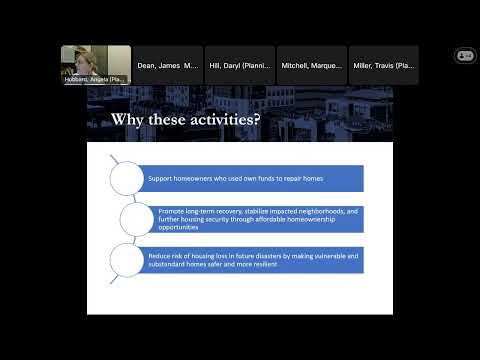
Hubbard gave a total program figure of $10,827,467 and described five categories of activity: homeowner reimbursement, rehab/reconstruction of acquired vacant properties to be sold to income‑eligible buyers, new construction for sale, mitigation awards, and administration. She said the grant is intended for long‑term recovery, not immediate response, and that beneficiaries are generally households at or below 80% of area median income.
On homeowner reimbursement, Hubbard said eligible households must have lived in the damaged home as their principal residence at the time of the disaster and still live there, must be income eligible, and must provide documentation such as invoices or receipts; Metro will perform a duplication‑of‑benefits analysis to account for FEMA, insurance or other assistance before reimbursing out‑of‑pocket costs. "We have confirmed with the long term recovery group that all claims for homes that still need repair, those cases have been closed," Hubbard said, while asking the public to report any remaining unmet cases.
For nonprofit‑led rehab and reconstruction, Metro plans to issue a request for proposals (RFP) to acquire vacant homes, rehabilitate or reconstruct them, and sell them to buyers at 80% of area median income with a 30‑year affordability requirement. The projects must meet environmental‑review standards, cannot be in flood plains or floodways, and must meet third‑party green‑building and wind‑resiliency requirements.
New construction was identified as a separate line with an activity budget of $7,000,000 targeted to most‑impacted zip codes. Hubbard said Metro is making a property at 2119 24th Avenue North available for development; the site requires rezoning and community engagement. Councilmember Tombs, who spoke during the hearing, described the parcel as a long‑vacant site and said the development could include "green space" or a pocket park for the neighborhood.
Hubbard said 15% of the grant (stated in the presentation as $1,640,000) is proposed for mitigation awards to nonprofits across the county to correct code deficiencies and incorporate resiliency measures, and that Metro may require liens or covenants to protect public investment. Administration is capped at 5% of the grant; Hubbard described the administrative portion as "a little over a half a $1,000,000" and said Metro may contract with firms experienced in federal procurement and environmental review.
Federal compliance requirements will apply to projects, Hubbard said: HUD environmental review, Davis‑Bacon prevailing‑wage requirements, Section 3 labor standards, civil‑rights obligations and HUD reasonable‑cost standards. Projects that already involve other federal funding may need to pause construction while environmental reviews and procurement matters are reconciled.
Hubbard summarized affordability rules for investments: 75% of funded homes must benefit households at or below 80% AMI; projects may be mixed‑income if 75% of homes funded by the grant are sold to buyers at or below 80% AMI and the remainder may serve buyers up to 120% AMI.
Next steps include finalizing the Metro action plan after public comments, submitting it to the Tennessee Department of Economic and Community Development and seeking state and HUD approvals. Hubbard said Metro will then seek Metro Council approval and appropriation this spring and hoped to launch program work in late summer. Projects and funds must be completed by Sept. 30, 2030.
During a public Q&A, Lucille asked about timing for site acquisition and construction under the $7 million new‑construction line; Hubbard said the RFP will require a development timeline that meets grant expenditure deadlines and that projects should complete well before the federal closeout. Chase asked whether the $7 million would be split across projects or awarded to a single developer; Hubbard said Metro will evaluate proposals on merit and may split funds or award to one project. An attendee asked whether activities cover all of Davidson County; Hubbard said most activities are targeted to the listed zip codes while the Metro property is in District 2.
Councilmember Aaron Evans asked how the city will reach homeowners who used their own funds to repair tornado damage. Hubbard said Metro will "scour every resource" including FEMA data, the long‑term recovery group, community partners, faith institutions and council members to find eligible homeowners and run robust outreach. Shabir Begani of Begani Education asked for details about the pocket‑park idea; Hubbard said rezoning, neighborhood meetings and land‑development staff will be the forum, and that park development could be an allowable RFP cost if not taken up by Metro Parks.
The public record for the hearing remains open: the presentation and recording will be posted to Metro's website, and written comments can be submitted by email to metrohousing@Nashville.org or at an in‑person meeting at the North Nashville precinct community room on Thursday at 5 p.m. Hubbard closed the virtual hearing and thanked participants.
What happens next: Metro will collect public comments, finalize and submit its action plan to the state for approval, then return to Metro Council this spring for appropriation. Any final program rules and beneficiary lists will be subject to state and HUD approval and may be revised; Metro staff said it will notify the public if activities or beneficiary criteria change.