Get Full Government Meeting Transcripts, Videos, & Alerts Forever!
Get email alerts on the Build To Scale topic
No spam. Unsubscribe anytime.
EDA details Build to Scale competition: $50M available, strict 1-to-1 match and Oct. 28 deadline
Summary
The Economic Development Administration told applicants the 2024 Build to Scale competition has $50 million available, expects roughly 40'0 to 50 awards (up to $5 million each), requires a statutory 1-to-1 nonfederal match, and sets applications due Oct. 28 at 4:59 p.m. Eastern.
The Economic Development Administration (EDA) outlined application requirements and evaluation priorities for its 2024 Build to Scale competition during a webinar hosted by the State Science & Technology Institute (SSTI).
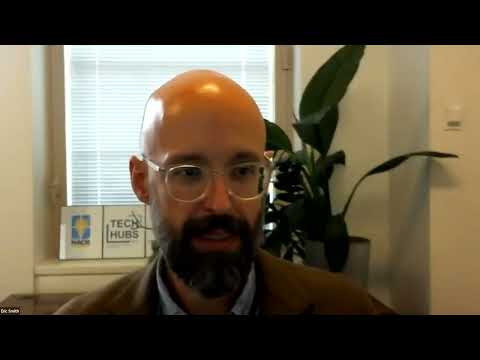
Eric Smith, tech hubs director at the Economic Development Administration, said Congress provided $50,000,000 for the program this year and EDA "expect[s] to make, approximately 40 to 50 awards," with individual grants ranging from several hundred thousand dollars up to $5,000,000. Smith emphasized that the program "is a pretty high match rate" and that a statutory "1 to 1 match is absolutely required." Applications must be submitted through EDA's Edge platform by 4:59 p.m. Eastern on Oct. 28; late submissions will not be accepted.
Why it matters: Build to Scale funds intermediary organizations that support technology entrepreneurs and regional innovation ecosystems. The awards aim to help regions commercialize technologies, expand access to risk capital and grow workforce capacity; successful applications typically outline measurable outcomes and sustainability plans.
Details applicants should know
Who may apply and support letters: Smith clarified eligible lead applicants (states, cities, counties, federally recognized tribal governments, nonprofit organizations, institutions of higher education, federal labs, public-private partnerships and consortia). He warned that non-governmental applicants must include a support letter from a state or political subdivision (for example, a city or county). "Federal officials or federal entities" (for example, a member of Congress or a federal program) do not satisfy that statutory requirement.
Eligible activities and limits: The program funds non-construction, operational and programmatic costs such as equipment, shared facilities and activities to form and deploy equity-based capital (angel, seed or venture vehicles). Smith said EDA "cannot" fund direct transfers to startup companies or individuals, cannot use grant or match funds as investment capital, and does not support pure debt financing.
Match and commitments: Smith reiterated the statutory 1-to-1 match requirement (nonfederal cash or in-kind). He said the proportion of cash versus in-kind is not capped and that "you could have all cash. You could have all in kind," but cautioned that in-kind valuations must be realistic and well-documented. Match is calculated at the overall application level, so subrecipients can collectively contribute to the required share. Match letters should demonstrate the funds are "committed, unrestricted and unencumbered."
Application mechanics and required documents: Applicants must have a UEI, be registered in SAM.gov, and create and submit their application through Edge. Required documents include the project narrative, a budget narrative and staffing plan, SF-424 and SF-424A forms, and a CD-511 (lobbying disclosure) where applicable. Applicants must specify their project service area using county-level FIPS codes.
Evaluation priorities and common mistakes: EDA's updated 2024 NOFO combines prior streams into an "implementation challenge." Competitive proposals should address four areas: strengthening economic competitiveness; accelerating commercialization; remediating structural barriers to translating innovation into economic activity; and leveraging regional competitive strengths. Smith listed frequent application errors: missing or weak match evidence, unrealistic in-kind valuations, and absent state/local support letters (which can cause ineligibility).
Q&A highlights: Smith said there is no strict limit on how many Build to Scale applications a Tech Hub or an NSF engine may endorse but recommended alignment around a cohesive regional strategy. He advised that broadly defined multi-state proposals must demonstrate meaningful coordination and a credible plan to deliver measurable impact. On the use of other federal funds as match (for example, SSBCI or ARPA), Smith said eligibility "needs to be stated explicitly in the statute" and urged applicants with questions to contact EDA at oie@eda.gov for case-by-case guidance.
Next steps and follow-up: The competition launched Sept. 9; award announcements are planned for winter 2024'025 and projects are expected to start in winter 2025. SSTI will share the webinar recording, slides and example materials, and EDA will post FAQs and accept questions at oie@eda.gov.
"Read the NOFO," Smith said repeatedly during the session, noting it contains crucial definitions and all application details. "If you've got questions about eligibility, reach out to the OIE inbox," he added.
Ending: SSTI said it will circulate the slides and supplemental resources, and encouraged applicants to begin registering in SAM.gov and assembling match and support letters well before the Oct. 28 deadline.