Lifetime Citizen Portal Access — AI Briefings, Alerts & Unlimited Follows
OCO director Jeremiah emphasizes raising disciplinary standard, tackling gang tags and contraband pathways
Loading...
Summary
Jeremiah, the new director of the Office of the Corrections Ombuds, used the quarterly public meeting to lay out three oversight priorities — disciplinary infractions, security-threat-group tags, and drug smuggling — and described a new process to refer probable-cause matters to the DOC secretary for outside prosecution.
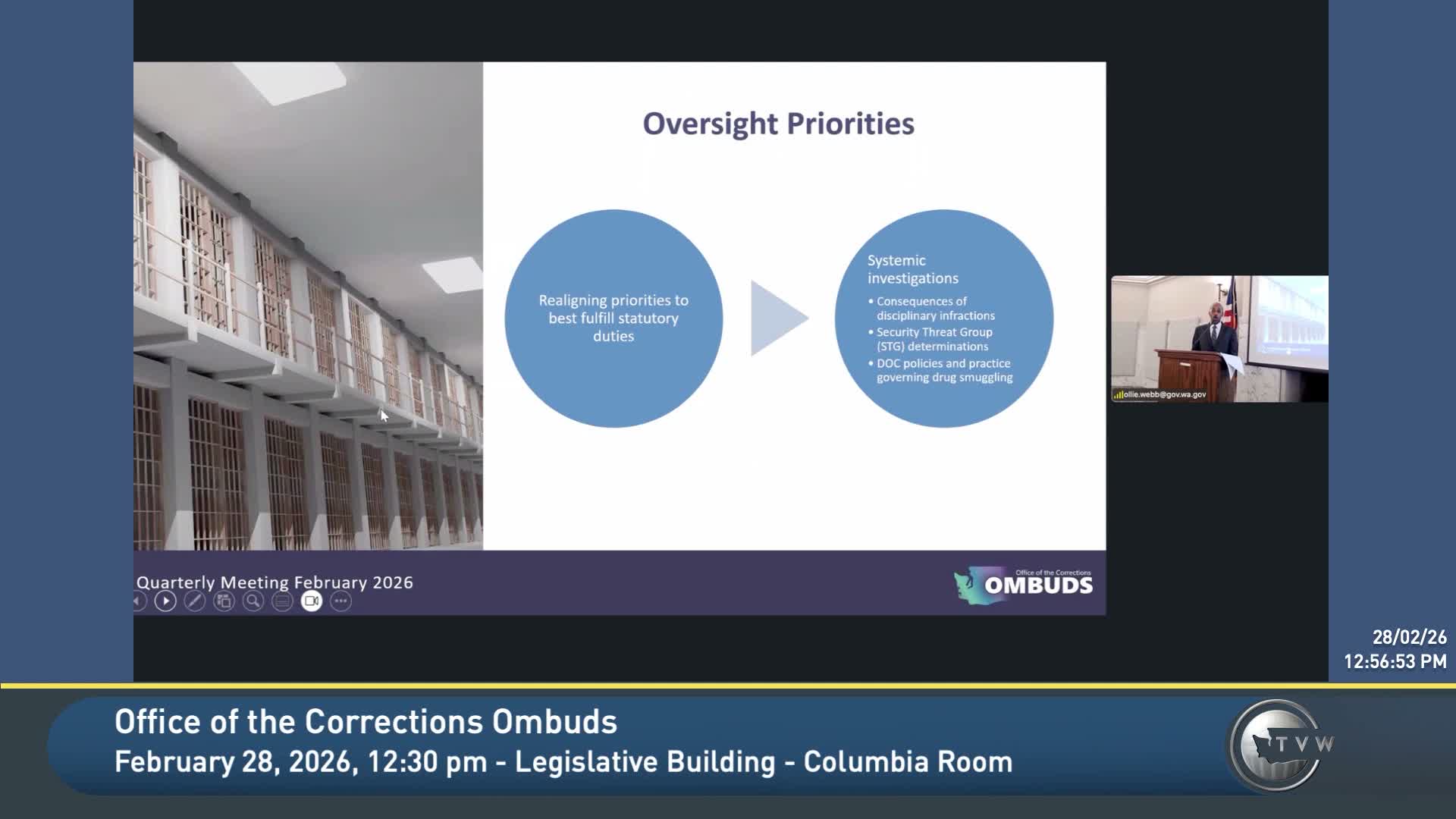
Jeremiah, director of the Office of the Corrections Ombuds, used the agency’s quarterly public meeting to introduce himself and lay out three central oversight priorities: the consequences of disciplinary infractions, the long-term impact of security-threat-group labels, and policies governing drug smuggling into correctional facilities.
He said those priorities stem from his years inside the system and his legal training. Quoting the statute for the director’s role, he said the ombudsman “must be a person of recognized judgment, independence, objectivity, and integrity, and be qualified by training or experience in corrections law and policy.” He framed his own externships and clerkship as part of demonstrating that background.
On disciplinary infractions, Jeremiah criticized the department’s low evidentiary standard and said the office will investigate systemic consequences. “Right now, as things exist, it’s, any evidence is pretty much the standard,” he said, adding that the Department of Corrections has agreed to move policies toward a preponderance standard but that implementation requires funding. He argued the current standard can alter parole, resentencing and parental rights, and said the office will push for clearer, fairer standards.
Jeremiah identified the second priority as security-threat-group tagging, saying labels attached to people for decades can block progress even after an individual has changed. He raised questions about how tags are validated and what processes are available for people to demonstrate they are no longer members.
The third priority addresses drug smuggling routes into facilities. Drawing on decades inside, Jeremiah said staff compromise is a common route and cautioned against narratives that single out visitors. He said the office will seek honesty about how contraband is introduced and pursue policy solutions accordingly.
He described a new agreement with the DOC secretary on probable-cause referrals: when OCO investigators identify probable cause that a crime occurred within the department, the office “can write a public-facing legal memorandum to the secretary of DOC referring outside prosecution,” a step he said will reduce the silence around alleged facility crimes while recognizing that ultimate charging decisions lie with elected prosecutors.
Using a recent example, Jeremiah said the office raised concerns about a DOC fiscal note tied to HB 1317 (a bill he described as related to juvenile resentencing opportunities) with the governor’s office and DOC; he reported the fiscal note was revised within a week after outreach. He said the office can and will engage on legislative and fiscal issues but must balance statutory limits and compromise.
On operations, Jeremiah said the OCO is recruiting a new deputy after Elizabeth Kingsbury’s transfer, will appoint retired Judge George Fearing as a strategic adviser, and is expanding capacity through partnerships with Seattle University and Gonzaga Law School. He also said the office will convene a construction oversight committee to create apprenticeship pathways for people involved in trades programming.
Jeremiah acknowledged concerns about his relationships with people on the inside and said he will not visit facilities alone, will bring a community relations manager into visits, and is working with the attorney general’s office to develop access policies. He also signaled a policy memo to clarify the office’s view that the Indeterminate Sentencing Review Board (ISRB) falls outside OCO jurisdiction.
The director closed by urging community support ahead of a statutory sunset review, underscoring that the office’s continuation will depend in part on public advocacy and legislative review.