Get Full Government Meeting Transcripts, Videos, & Alerts Forever!
Get email alerts on the Twist Device topic
No spam. Unsubscribe anytime.
Idaho National Laboratory engineers detail TWIST system used in TREAT to test fuel under accident conditions
Summary
INL engineers described the TWIST (Transient Water Irradiation System) used with the TREAT reactor to simulate loss-of-coolant accidents, outline instrumented capsule design and fabrication steps, and explain reactor insertion and post-test analysis that inform next-generation light-water reactor fuel performance.
Colby Jensen, who works in the fuel design and development qualification group at Idaho National Laboratory, said the TWIST device is used "to test the performance of nuclear fuels under accident conditions." Jensen opened a technical presentation outlining how INL leverages the Advanced Test Reactor, the Hot Fuels Examination Facility and the Transient Reactor Test Facility (TREAT) to execute instrumented irradiation experiments.
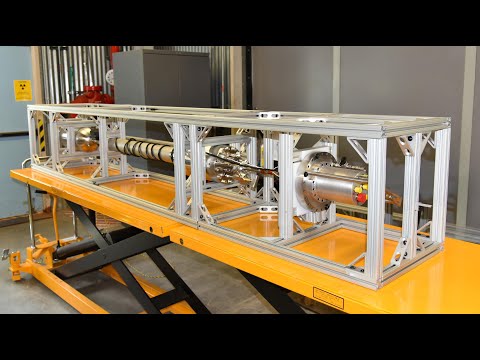
The TWIST name stands for Transient Water Irradiation System for TREAT. "The TWIST device is a fairly complex irradiation test device," Jensen said, and it is designed to support tests that simulate a loss-of-coolant accident — a scenario in which a reactor's primary coolant leaves the pressure vessel and the fuel is no longer actively cooled.
Clint Anderson, an experiment design engineer at Idaho National Laboratory, described the design workflow: experiments begin with objectives and hand sketches, then move into computer-aided design and nuclear and thermal analysis. Anderson said teams produce mock-ups and conduct out-of-reactor testing before fabricating final parts and assembling the experiment in the Measurement Sciences Laboratory. He emphasized instrumentation integration as a major challenge: "We want to monitor the phenomena that's happening inside of the experiment with various instrumentation," Anderson said, noting the difficulty of routing sensors through multiple sealed flanges.
A presenter on the assembly line described the capsule internals and sensor suite: a fuel specimen sits inside the rosette body, with a center-line thermocouple and additional pressure, fiber-optic and acoustic sensors routed through capsule flanges. The team prepares lines for a future blowdown valve and coordinates handoff of the finished fuel assembly to staff at the Materials and Fuels Complex for final completion.
Connor Michlick, a research engineer who builds and qualifies radiation experiments, walked through component-level fabrication and qualification. He said fuel pellets are sourced from a commercial manufacturer, then qualified and modified at INL; one such modification is drilling a center-line hole to insert a thermocouple to record internal fuel temperature during transients. Michlick described assembly steps including cleaning parts, press-fitting components, performing circumferential and final perimeter welds in a laser welder housed in an inert-atmosphere glove box, and conducting post-weld inspections such as leak checks, dye-penetrant tests and visual weld examinations.
Michlick said the assembled fuel segment is inserted into the capsule, where thermocouples are welded to the cladding and the capsule halves are mated and bolted to create a leakproof seal. After verifying seals and placing the capsule in a shipping cage, INL moves the assembly to TREAT for final installation and qualification.
Travis Callison, a senior reactor operator at TREAT, described operations at the reactor: the capsule arrives in a shipping frame, is filled with water and inerted to prevent oxidation, and then undergoes a helium leak check once installed inside the facility’s primary containment vessel (referred to in the presentation as the Big Buster). Before an experimental campaign, operators load a neutron-equivalent dummy (NED) to perform core characterization and confirm the reactor neutronics will produce the expected transient behavior. Once the characterization is complete, the NED is removed, the TWIST capsule is inserted, instrumentation is connected, and the transient test is executed.
Jensen closed by describing the testing cadence: after extensive coordination the simulated accident and transient test are executed over a matter of minutes; the experiment then returns to world-class examination facilities for detailed diagnosis. "From these experiments, the data that's collected is used to support the safe and efficient performance of the next generation light water reactor fuels," he said.
The presentation documented the end-to-end technical workflow — from design and instrumentation challenges to fabrication, leak verification, reactor insertion and post-test analysis — that supports transient fuel testing at INL and TREAT.